
Identifying effective forex strategies during periods of high market volatility is paramount for capital preservation and profit generation. High volatility in currency markets means rapid price swings, driven by economic news, geopolitical events, or shifts in market sentiment. Successfully navigating these conditions requires a robust approach that prioritizes risk control before even considering entry points.
Understanding Market Volatility in Forex
Forex volatility refers to the degree and speed of price fluctuations for a currency pair. Forex volatility refers to the degree and speed of price fluctuations for a currency pair. In essence, it's a measure of how much a currency's value is expected to change over a given period. Markets become volatile when there's significant uncertainty or a rapid influx of new information that causes traders to adjust their positions quickly. Common triggers include:
- Interest rate announcements by central banks (e.g., Federal Reserve, European Central Bank).
- Major economic data releases (e.g., Non-Farm Payrolls, GDP reports).
- Geopolitical events (e.g., elections, international disputes).
- Unexpected 'black swan' events.
For example, during the initial stages of the COVID-19 pandemic in March 2020, many major currency pairs experienced extreme volatility, with rapid and often unpredictable price movements. This presented both immense risk and opportunity. Traders who understood that volatility often creates temporary inefficiencies could potentially profit, but only if their risk management was solid. Without it, the potential for rapid losses was equally, if not more, significant.
Volatility isn't inherently good or bad; it's a characteristic of the market. High volatility offers larger potential profit targets but also amplifies risk. Low volatility often means slower price action, potentially smaller profits, and less immediate risk.
Prioritizing Risk Management Before Strategy Selection
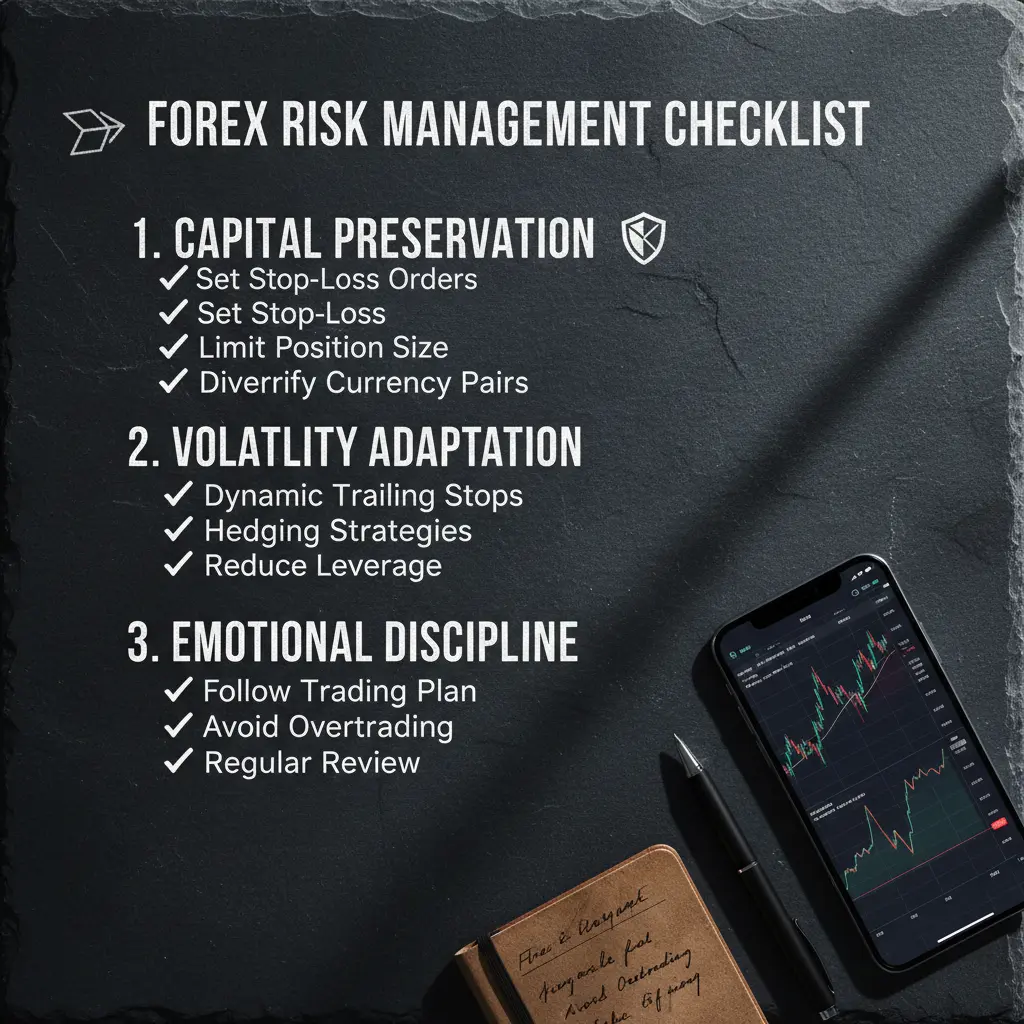
Before even thinking about which forex strategy might work best in volatile conditions, the absolute first priority must be robust risk management . Before even thinking about which forex strategy might work best in volatile conditions, the absolute first priority must be robust risk management. Without this foundation, any strategy is likely to fail spectacularly when tested by market turbulence. This involves several key components:
- Position Sizing: Determine how much capital you will risk per trade, typically as a small percentage (e.g., 1-2%) of your total trading capital. This is non-negotiable.
- Stop-Loss Orders: Always define your maximum acceptable loss for a trade and place a stop-loss order accordingly. In volatile markets, wider stops might be necessary to avoid being prematurely stopped out by noise, but this must be balanced against your risk percentage.
- Risk-Reward Ratios: Ensure that your potential profit target for a trade is significantly larger than your potential loss. A common target is 1:2 or 1:3 (risk 1 unit to potentially gain 2 or 3 units).
- Diversification (if applicable): While often discussed in stock investing, in forex, it can mean not overexposing your account to a single currency pair or trading heavily correlated pairs simultaneously without adjustment.
Consider a trader holding a $10,000 account. If they risk 2% per trade, that's $200 maximum loss per trade. If they are trading EUR/USD and the stop loss is set at 50 pips, this dictates the lot size. If the pip value for their account size is $10 per pip, a 50-pip stop loss means a potential $500 loss, which exceeds the 2% risk limit. To adhere to the 2% rule, they would need to reduce their lot size or adjust their stop loss. In volatile markets, a price move of 50 pips can happen in minutes, highlighting the need for strict adherence to these rules.
Strategies That Can Perform in Volatile Markets
Once risk management is locked down, specific strategies can be more effective in volatile environments. Once risk management is locked down, specific strategies can be more effective in volatile environments. These typically involve quick entries and exits or strategies that capitalize on rapid price movements.
1. Breakout Strategies
Breakout strategies aim to capture the rapid price movement that often follows a period of consolidation when a currency pair breaks through a key support or resistance level. Breakout strategies aim to capture the rapid price movement that often follows a period of consolidation when a currency pair breaks through a key support or resistance level. In volatile markets, these breakouts can be sharp and swift, offering quick profit potential.
Scenario: A currency pair like USD/JPY has been trading in a tight range between 108.50 and 109.00 for several days. A significant piece of economic news is expected. A breakout strategy would involve placing buy orders just above 109.00 or sell orders just below 108.50, expecting a strong move in the direction of the break.
- Situation: USD/JPY consolidates around 108.75.
- Recommended Option: Place a buy stop order at 109.10 and a sell stop order at 108.40, with tight stop losses just on the other side of the breakout candle.
- Alternative Option: Wait for confirmation of the breakout and retest of the broken level before entering. This is safer but might miss the initial sharp move.
- What to Avoid: Chasing the price significantly after a breakout without confirmation or a defined stop loss.
- Explanation: Volatile markets often produce powerful breakouts. Trading the initial surge can be profitable, but strict risk controls are essential as false breakouts can occur.
2. Scalping
Scalping involves making numerous trades throughout the day, aiming to capture small profits from minor price changes. Scalping involves making numerous trades throughout the day, aiming to capture small profits from minor price changes. This strategy requires speed, discipline, and a very low tolerance for losses. In volatile markets, the rapid price action can provide the frequent small movements scalpers need.
Scenario: A scalper monitoring GBP/USD notices quick fluctuations of 5-10 pips around a specific price level during a news event. They might enter a trade expecting a quick 3-5 pip gain, exiting immediately once hit, with a very tight stop loss of 2 pips.
- Situation: GBP/USD is fluctuating rapidly around 1.2550.
- Recommended Option: Enter multiple trades expecting 3-5 pip gains, with a 2-pip stop loss.
- Alternative Option: Focus on longer-term trades and avoid scalping during extreme volatility to prevent information overload and high transaction costs.
- What to Avoid: Letting small profits turn into losses by not exiting quickly or widening stops excessively.
- Explanation: Scalping thrives on rapid, small price movements. Volatile markets can offer these frequently, but the high frequency of trades and tight stops demand peak concentration and low latency execution.
3. Trend Following with Larger Stops
While often associated with smoother markets, trend following can work in volatile conditions if adapted. While often associated with smoother markets, trend following can work in volatile conditions if adapted. The key is to identify the dominant trend that emerges after initial whipsaws and to use wider stops to accommodate the increased price swings. This strategy requires patience to let the trend unfold.
Scenario: Following a significant economic announcement that sparks a strong upward trend in AUD/USD, a trader enters long. Instead of a typical 30-pip stop, they might set a 70-pip stop loss, reflecting the increased market noise, while aiming for a much larger profit target (e.g., 200 pips).
- Situation: AUD/USD begins a strong upward trend after a RBA interest rate hike announcement.
- Recommended Option: Enter long and set a wider stop loss (e.g., 70 pips) based on Average True Range (ATR) or previous volatility, targeting a significant profit.
- Alternative Option: Use trailing stops aggressively to lock in profits as the trend progresses, but be prepared for earlier exits if the trend falters.
- What to Avoid: Using very tight stops that are likely to be hit by normal volatility, or entering late into a trend that shows signs of exhaustion.
- Explanation: Volatility can create strong, sustained trends. By widening stops to ride out the noise, traders can benefit from these extended moves, provided their risk per trade remains within acceptable limits.
What Matters First: The Hierarchy of Trading Decisions
The order in which you consider trading elements is critical, especially in fast-moving markets. The order in which you consider trading elements is critical, especially in fast-moving markets. A misstep in priority can be costly.
Here's a practical hierarchy:
- Risk Management: Always the first consideration. How much can you afford to lose on this trade and overall? What is your stop-loss placement, and does it align with your risk percentage?
- Market Context/Setup: What is the overall market condition (trending, ranging, volatile)? What is the specific setup (breakout, pullback, reversal)? Does this setup align with your strategy's strengths?
- Strategy Execution: If the first two criteria are met, then execute your chosen strategy entry signal.
- Trade Management: Once in a trade, how will you manage it? Will you trail your stop, take partial profits, or let it run?
- Exit Strategy: Know your profit target and your maximum acceptable loss (your stop loss).
Scenario: A trader sees a potential setup for a currency pair they follow. They are excited about the price action and want to enter immediately. However, before placing the trade, they pause to consider their risk. They have a $5,000 account and are willing to risk 1% ($50) per trade. Their chosen strategy indicates an entry point with a required stop loss that, given their standard lot size, would risk $80. This setup is immediately rejected because the risk exceeds their pre-defined limit. The correct action was to adjust lot size to fit the $50 risk, or find a different trade.
- Situation: Potential trade setup identified.
- Recommended Option: Assess risk parameters (account size, % risk, stop loss distance) and ensure they align before considering entry.
- Alternative Option: Place the trade immediately based on the perceived setup and adjust risk later if necessary (highly discouraged).
- What to Avoid: Letting the excitement of a perceived opportunity override the discipline of risk assessment.
- Explanation: Prioritizing risk ensures that even if the trade goes against you, the impact on your overall capital is manageable, allowing you to stay in the game for the next opportunity.
Tools to Help Navigate Volatility
Several tools can assist traders in managing volatility and executing strategies effectively: Several tools can assist traders in managing volatility and executing strategies effectively:
- Volatility Indicators: Tools like the Average True Range (ATR) can help quantify market volatility. ATR measures the average price range over a specified period, providing objective data to set stop-loss levels or identify periods of high/low volatility.
- Economic Calendars: Essential for anticipating volatility. Knowing when high-impact news events are scheduled allows traders to prepare, potentially avoid entering trades just before major releases, or even position themselves for the expected move if they have a strong conviction and risk controls in place.
- Trading Journals: Crucial for analyzing performance. A trading journal helps you track not just your wins and losses but also the market conditions, the strategies used, and your adherence to risk management rules during volatile periods. This post-trade analysis is invaluable for refinement.
- News Aggregators and Alert Systems: Real-time news can significantly impact volatile markets. Subscribing to reliable financial news feeds or setting up alerts for key economic data can provide timely information.
Scenario: A trader notices that EUR/USD has seen its ATR spike from 15 pips to 50 pips over 24 hours. They understand this indicates significantly increased volatility. Based on this, they adjust their typical stop-loss distance for EUR/USD trades from 20 pips to 40-50 pips to accommodate the market's increased movement, while ensuring the monetary risk (per-trade dollar loss) remains constant by adjusting position size.
- Situation: ATR for a currency pair suddenly increases.
- Recommended Option: Use the increased ATR to set wider, more appropriate stop-loss levels, and adjust position size to maintain consistent monetary risk.
- Alternative Option: Ignore the ATR increase and stick to previous stop-loss distances, leading to premature exits.
- What to Avoid: Using fixed stop-loss distances that do not adapt to changing market conditions.
- Explanation: Objective measures like ATR provide crucial context for setting realistic stop losses and managing risk effectively in dynamic market environments.
Common Pitfalls in Volatile Forex Markets
Many traders falter when volatility spikes. Many traders falter when volatility spikes. Awareness of these common mistakes is the first step to avoiding them:
Table: Volatility Pitfalls and Solutions
| Pitfall | Description | Solution |
|---|---|---|
| Over-leveraging | Using excessive leverage to magnify potential gains, which equally magnifies losses in fast markets. | Strictly adhere to pre-defined position sizing rules based on a small percentage of capital. |
| Emotional Trading | Making impulsive decisions based on fear or greed triggered by rapid price swings. | Follow a pre-defined trading plan and use checklists for entry and exit decisions. |
| Ignoring News Events | Trading without awareness of scheduled economic releases that can cause sudden volatility. | Consult an economic calendar and consider reducing exposure or staying out of the market around major events. |
| Widening Stops Too Much | Increasing stop-loss distances beyond acceptable risk limits in an attempt to avoid being stopped out. | Maintain fixed monetary risk per trade; if a stop needs to be wider, reduce position size accordingly. |
| Chasing the Market | Entering trades late after a significant move has already occurred, increasing the risk of a reversal. | Wait for retracements or pullbacks in the direction of the established trend, or for clear breakout confirmations. |
| Neglecting Risk-Reward | Focusing only on win rate and accepting trades with poor potential profit compared to risk. | Only take trades where the potential profit is at least 2-3 times the potential loss. |
Scenario: A trader gets stopped out of a trade due to a sudden spike. Instead of accepting the loss, they immediately re-enter the same trade, convinced the market is wrong, without re-evaluating the stop loss or position size. This is an example of chasing the market and emotional trading.
- Situation: A trader is stopped out of a trade.
- Recommended Option: Review the trade, analyze what went wrong, and if a new setup presents itself, re-enter only after a disciplined re-assessment of risk and strategy alignment.
- Alternative Option: Immediately re-enter the same trade without further analysis, driven by a desire to 'win back' losses.
- What to Avoid: Revenge trading or making decisions based on the emotion of wanting to recover losses quickly.
- Explanation: Volatility can trigger emotional responses. Sticking to a disciplined process, including re-evaluation after a loss, is crucial for long-term survival.
Is it Worth Trading Volatile Forex Markets?
Trading volatile forex markets can be highly rewarding for disciplined traders who have mastered risk management. Trading volatile forex markets can be highly rewarding for disciplined traders who have mastered risk management. The increased price movement offers larger profit potentials and opportunities to capitalize on rapid market shifts. However, it also magnifies the consequences of poor risk controls. For new traders, it is often advisable to gain experience in less volatile conditions before actively seeking out extreme volatility. Understanding the tools and strategies discussed, and crucially, prioritizing risk management above all else, are the cornerstones of successfully navigating these challenging yet potentially lucrative market environments. Remember, the goal isn't to avoid volatility but to manage the risks associated with it effectively.
For a deeper dive into managing your trades and capital, explore our resources on risk management and trading journals.
Use the matching tool. The risk calculator helps turn this guide into a usable decision before the trade.
Related reading: trading risk management | risk reward ratio