
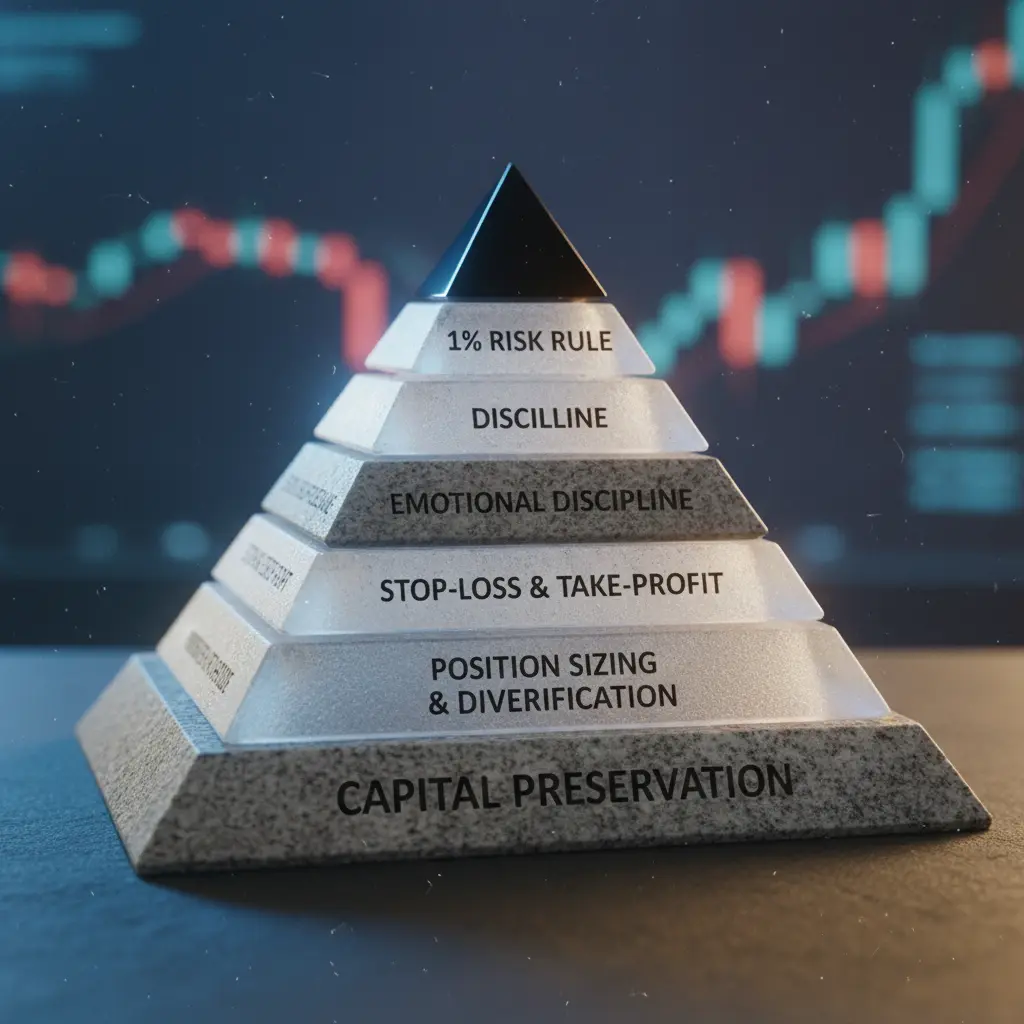
The 1 percent risk rule is a foundational strategy for protecting trading capital by limiting potential losses on any single trade to 1% of the total trading account. This disciplined approach prevents catastrophic losses, allowing traders to remain in the market long enough to develop their skills and capitalize on opportunities.
Why 1 Percent Risk is Crucial for Traders
Imagine a trading account of $10,000. Under the 1 percent rule, the maximum you'd risk on any one trade is $100. This might seem small, but its power lies in consistency and capital preservation. Without it, a string of just a few losing trades could decimate an account, making recovery nearly impossible. For instance, losing 50% of a $10,000 account means you need a 100% gain to break even, a monumental task. Limiting risk to 1% means even a bad streak of ten consecutive losses would only reduce the account by 10%, a much more manageable deficit.
This rule instills discipline, forcing traders to think critically about trade setup, entry points, and exit strategies before committing capital. It's not about avoiding losses entirely, as losses are an inherent part of trading. Instead, it's about controlling the size of those losses so they don't jeopardize your trading career. Many professional traders and experienced educators consistently advocate for this approach, especially for those new to the markets or trading with smaller accounts. It fosters a mindset where survival and consistent small gains are prioritized over chasing huge, high-risk wins.
Calculating Your Maximum Risk Per Trade
Applying the 1 percent rule requires a clear understanding of your total trading capital and how to calculate your stop-loss distance in terms of dollar value. Let's use that $10,000 account again. One percent of $10,000 is $100. This $100 is your absolute limit for any trade, encompassing potential losses from your entry price to your stop-loss price, including any commissions or slippage.
The calculation for position sizing becomes straightforward:
Risk Amount = Account Balance Risk Percentage (e.g., 0.01 for 1%)
Then, to determine the number of units (e.g., shares, lots) to trade:
Position Size = Risk Amount / (Entry Price - Stop Loss Price)
For example, if you want to buy Apple (AAPL) at $170 and set a stop-loss at $168, your risk per share is $2. With a $100 maximum risk on a $10,000 account, you can buy $100 / $2 = 50 shares. This ensures that if AAPL drops to $168, your loss is precisely $100.
Scenario: Trading Forex EUR/USD
Situation: You have a $5,000 trading account and identify a potential long trade on EUR/USD. Your entry is 1.0850, and you plan to set your stop-loss at 1.0820. The pip value for a standard lot is $10.
Recommended Option: Calculate your maximum risk per trade. 1% of $5,000 is $50. The distance to your stop-loss is 30 pips (1.0850 - 1.0820). Since each pip is worth $10, a 30-pip stop loss would cost $300 per standard lot. To risk only $50, you need to trade 0.16 standard lots ($50 / ($30 10)). Most brokers allow trading in micro-lots (0.01), so you'd trade 16 micro-lots.
Alternative Option: Trade a full standard lot. This would risk $300 per trade, which is 6% of your $5,000 account ($300 / $5000). This violates the 1% rule.
What To Avoid: Placing the stop-loss without considering the account size and risk percentage, leading to oversized positions and excessive risk.
Explanation: By adhering to the 1% rule, you ensure that even if this trade goes against you, the loss is contained to $50, representing only 1% of your capital, allowing for many more opportunities.
Common Mistakes and How to Avoid Them
One of the most frequent missteps is not accounting for commissions and slippage in the risk calculation. If you're targeting a $100 risk but your stop-loss order is filled at a slightly worse price due to market volatility, your actual loss could exceed $100. Always add a small buffer to your stop-loss distance to account for these costs. Another error is adjusting the risk percentage based on trade conviction. A trader might feel very confident about a particular setup and decide to risk 2% or 3%. This is a slippery slope. The 1 percent rule should be applied consistently, regardless of how 'sure' a trade feels. Emotions can cloud judgment, and a rigid risk management plan helps counteract that.
Failing to adjust risk when the account balance changes is also problematic. If your account grows to $11,000, your new 1% risk limit becomes $110. If your account shrinks to $9,000, your limit drops to $90. Many traders forget to recalculate, either risking too much on a larger account or unnecessarily restricting themselves on a smaller one. Finally, many new traders use a fixed dollar amount for risk instead of a percentage. While the 1% rule dictates a dollar amount, it's a percentage of the current account balance. If your balance fluctuates, your dollar risk should too.
Scenario: Day Trading Futures
Situation: A day trader with a $20,000 account is looking at the S&P 500 E-mini futures (ES). Their planned entry is 4500.00, with a stop-loss at 4495.00. The point value for ES is $50.
Recommended Option: Calculate 1% of $20,000, which is $200. The stop-loss is 5 points away. The cost per point is $50, so a 5-point stop loss on one contract costs $250 (5 points $50). To risk only $200, the trader should use less than one contract or widen their stop slightly. A common adjustment is to trade 0.8 contracts if the broker allows, or accept a slightly wider stop to capture the full contract.
Alternative Option: Trade one full contract. This risks $250 per trade (5 points $50), which is 1.25% of the $20,000 account. This slightly exceeds the 1% rule.
What To Avoid: Ignoring the point value and simply placing a stop-loss without calculating the exact dollar risk, potentially exposing the account to a loss far exceeding the intended 1%.
Explanation: By carefully calculating the position size based on the 1% rule and the contract's point value, the trader ensures the maximum loss on this futures trade is capped at $200.
Integrating the 1 Percent Rule with Trading Journals
A trading journal is indispensable for reinforcing risk management principles like the 1 percent rule. Each trade entry in your journal should meticulously record the account balance at the time of the trade, the planned risk percentage, the calculated risk amount, the stop-loss level, and the actual dollar amount risked. This documentation provides immediate feedback.
When reviewing your journal, you can quickly spot any deviations from the 1 percent rule. Did you take a trade where the risk was 1.5%? Why? Was it an oversight, or did you consciously decide to break the rule? Documenting these decisions and their outcomes helps in self-correction. For instance, if you notice a pattern of exceeding your risk limit on trades you felt 'sure' about, your journal can highlight this bias. You can then use this insight to strengthen your adherence to the rule in future trades. The objective is to build a consistent habit, and the journal serves as your accountability partner. Without this record-keeping, it's easy to let bad habits creep back in. Explore the benefits of a trading journal to understand how it supports disciplined trading.
| Trade Parameters | Calculation/Action | Result |
| Account Balance | (Example) $10,000 | N/A |
| Risk Percentage | 1% | $100 Maximum Risk |
| Asset | USD/JPY | N/A |
| Entry Price | 150.50 | N/A |
| Stop Loss Price | 150.25 | N/A |
| Risk Per Unit (Pip) | 25 Pips | N/A |
| Pip Value (Standard Lot) | $8.25 (approx. for USD/JPY) | N/A |
| Max Risk per Lot | 25 pips $8.25/pip = $206.25 | N/A |
| Position Size Calculation | $100 (Max Risk) / $206.25 (Risk per Lot) | 0.48 Lots (Approx.) |
| Trade Execution | Trade 0.48 standard lots (or 4.8 mini-lots if available) | Actual risk is $100, or very close, depending on fractional lot availability. |
Scaling Risk with Account Growth and Drawdowns
The 1 percent rule is dynamic; it should adjust with your account's performance. As your account balance increases, so does your maximum risk amount in dollar terms. If your $10,000 account grows to $12,000, your 1% risk limit becomes $120. This allows you to take slightly larger positions or absorb more significant price movements on your standard stop-loss distances.
Conversely, during a drawdown, your risk limit must decrease. If your $10,000 account falls to $8,000, your 1% risk limit shrinks to $80. This is counterintuitive for some traders who might feel tempted to 'make back' losses faster by increasing risk. However, the opposite is necessary. Reducing the dollar amount risked per trade during a drawdown helps to arrest the decline and provides a buffer for recovery. It means you might need to trade smaller position sizes or accept tighter stop-losses. This is a critical aspect of capital preservation; it's about playing the long game, not quick fixes.
Scenario: Recovering from a Drawdown
Situation: A trader started with $15,000, adhered to the 1% rule ($150 risk per trade), but experienced a series of losses, reducing the account to $12,000.
Recommended Option: Immediately recalculate the 1% risk. The new maximum risk per trade is $120 (1% of $12,000). Adjust position sizes accordingly. If a previous trade risked $150 on 100 shares with a $1.50 stop, the trader now needs to risk $120. This might mean trading 80 shares (80 $1.50 = $120) or slightly adjusting the stop-loss.
Alternative Option: Continue risking $150 per trade to 'catch up'. This would mean risking 1.25% of the current $12,000 account ($150 / $12000), which accelerates losses during further drawdowns.
What To Avoid: Letting ego or frustration dictate risk levels. Sticking to the revised, lower risk amount is paramount for recovery.
Explanation: By lowering the dollar risk per trade during a drawdown, the trader protects against further significant losses and creates a more sustainable path to rebuilding their account equity.
Is the 1 Percent Rule Always the Best Option?
While the 1 percent rule is a robust starting point, experienced traders might adjust their risk percentage. Some might choose 0.5% for highly speculative trades or volatile markets, while others with larger, more established accounts might opt for 1.5% or even 2% on occasion, provided they have a proven edge and robust risk management strategies in place. However, venturing beyond 2-3% per trade dramatically increases the probability of a catastrophic loss, especially during volatile market conditions or periods of poor performance.
The effectiveness of the 1 percent rule also depends on the trading strategy. A high-frequency scalping strategy might have very tight stops and frequent trades, where a lower risk percentage per trade might be more appropriate to manage overall exposure. Conversely, a long-term swing trader might use wider stops and less frequent trades, where 1% could be a comfortable risk level. Ultimately, the goal is to find a risk percentage that allows you to trade frequently enough to gather data and learn, without risking a significant portion of your capital on any single event. Understanding your personal risk tolerance is key; some individuals may feel more comfortable with 0.5%, while others might adapt to 1.5% with experience. Consider exploring advanced portfolio analysis tools to better understand your overall risk exposure.
Scenario: Aggressive vs. Conservative Trader
Situation: Two traders, both with a $50,000 account, are evaluating the same breakout trade setup on NVDA.
Recommended Option (Conservative): Trader A uses the 1% rule, risking $500 per trade. They set a stop-loss that results in a position size of 20 shares, costing $500 if triggered.
Alternative Option (Aggressive): Trader B, feeling very confident, decides to risk 2% ($1,000). They might take a larger position size (e.g., 40 shares) or use a wider stop-loss, risking $1,000 if the trade fails.
What To Avoid: Trader B risking 5% or more on a single trade, regardless of conviction. This level of risk can lead to rapid account depletion.
Explanation: Trader A's approach ensures that a single losing trade only impacts their account by 1%, preserving capital for future opportunities. Trader B takes on significantly more risk, which, while potentially leading to larger gains if right, also exposes them to much faster and larger losses if wrong.
Scenario: Swing Trading a Major Currency Pair
Situation: A swing trader with $25,000 is looking to go long on GBP/USD, with an entry at 1.2500 and a stop-loss at 1.2400. The pip value for GBP/USD is $10 per standard lot.
Recommended Option: Adhere to the 1% rule. Maximum risk is $250. The stop-loss is 100 pips away. Since each pip is $10, a 100-pip stop loss on a standard lot costs $1,000. To risk only $250, the trader must trade 0.25 standard lots (or 2.5 mini-lots). This limits the loss to $250 if the stop-loss is hit.
Alternative Option: Trade 1 standard lot. This would risk $1,000 per trade, which is 4% of the $25,000 account ($1000/$25000). This is a high-risk approach for a single trade.
What To Avoid: Forgetting to adjust position size for the wide stop-loss, thereby risking far more than intended.
Explanation: By calculating position size based on the 1% risk limit and the wide stop-loss distance, the trader ensures that a potential loss remains within acceptable parameters.
The Psychology of Risk Control
The 1 percent rule is as much about psychology as it is about mathematics. It helps to demystify the potential outcomes of a trade. When you know the maximum you can lose is a small, predetermined percentage of your capital, it reduces anxiety and fear. This emotional detachment allows for clearer thinking and more objective decision-making. It shifts the focus from 'winning' or 'losing' individual trades to executing a consistently profitable strategy over time.
Fear of loss can lead traders to close winning positions too early or cut losing positions too late, or even avoid taking trades altogether. Greed, on the other hand, can lead to overtrading and holding onto losing positions for too long, hoping for a turnaround. The 1 percent rule acts as an emotional circuit breaker. It enforces a boundary that prevents fear and greed from dictating trading actions. By accepting and planning for small, controlled losses, traders can approach the market with more confidence and less emotional turmoil. This discipline is the bedrock of long-term success in trading.
Scenario: Overcoming Fear of Missing Out (FOMO)
Situation: A trader sees a stock or currency pair making a significant move and fears missing out on potential profits. They haven't properly analyzed the setup or calculated risk.
Recommended Option: Step back. If the setup doesn't meet your predefined trading criteria and risk parameters, do not trade it. Refer to your risk management plan, which mandates the 1% rule. If entering this trade would violate it, the answer is no.
Alternative Option: Jump into the trade impulsively, risking a larger percentage than usual due to FOMO.
What To Avoid: Chasing trades that have already moved significantly or entering without a clear stop-loss and position size calculation.
Explanation: Sticking to the 1% rule and predefined criteria prevents impulsive decisions driven by FOMO, ensuring that only well-analyzed, risk-managed trades are taken.
Scenario: Taking a Larger Position After a Win
Situation: A trader just won a trade and feels confident, wanting to increase their position size on the next trade to capitalize on their 'hot streak'.
Recommended Option: Stick to the 1% risk rule. The position size calculation should be based on the current account balance, not on recent profits. If the account grew slightly, the dollar risk might increase slightly, but the percentage remains 1%.
Alternative Option: Increase the risk percentage to 2% or 3% because of the recent win and perceived momentum.
What To Avoid: Linking risk size to recent trading performance rather than the account's total equity and a fixed risk percentage.
Explanation: The 1% rule prevents the trader from taking on excessive risk after a win, which could quickly erase profits and more. It maintains consistency regardless of recent outcomes.
Step-by-step trading workflow
Mastering the 1 Percent Risk Rule for Smarter Trading works better when the process is explicit. Use a short ordered checklist before you act.
- Define the setup and the exact reason it is on your radar.
- Measure the downside first, including stop distance and position size.
- Check whether the reward and market context still justify the trade.
- Log the plan so execution can be reviewed after the outcome is known.
Related reading: trading risk management | risk reward ratio | how to use a trading journal