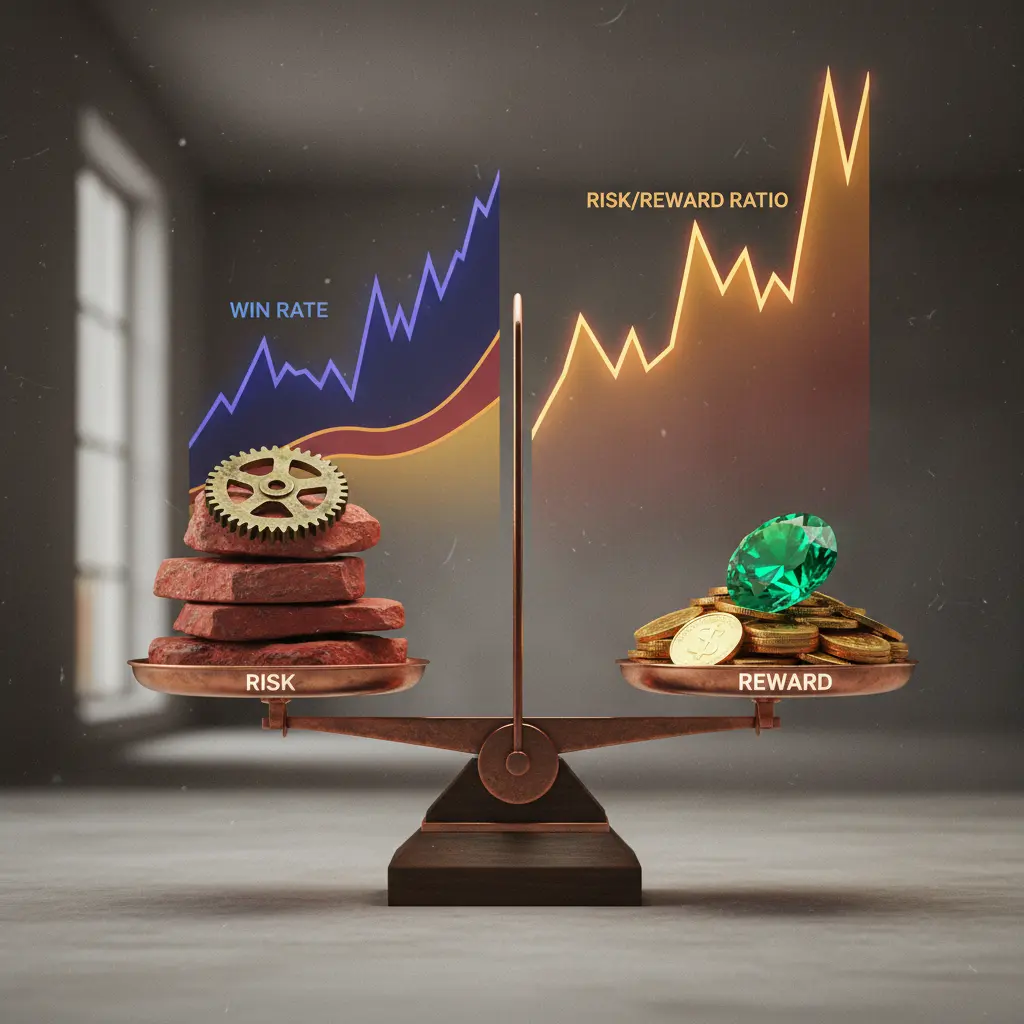
The most effective traders balance their Risk Reward Ratio and Win Rate, but understanding which to prioritize can unlock consistent profitability. While both metrics are vital for assessing trading performance, their relative importance shifts based on strategy and market conditions. This guide breaks down their impact and how to leverage them.
Understanding Risk Reward Ratio (RRR)
The Risk Reward Ratio (RRR) quantifies the potential profit of a trade relative to the potential loss. It's calculated by dividing the target profit (the difference between your entry price and your take profit level) by the risk (the difference between your entry price and your stop loss level). For example, a trade with a potential profit of $100 and a risk of $50 has an RRR of 2:1.
A higher RRR means you stand to gain more on winning trades than you lose on losing trades. This is a cornerstone of sound risk management. A strategy with a favorable RRR allows for a lower win rate and still remain profitable over time. Think of it as having a buffer; a few larger wins can offset several smaller losses. Many professional traders aim for RRR of 1.5:1 or higher, although this can depend heavily on the trading instrument and timeframe.
Consider a trader employing a strategy that targets a 2:1 RRR. This means for every $1 risked, they aim to make $2. Even if this strategy only has a 40% win rate (meaning 60% of trades are losers), it can still be profitable. Let's illustrate:
Imagine 10 trades, each risking $100:
- 4 winning trades: 4 $200 profit = $800
- 6 losing trades: 6 $100 loss = -$600
- Net Profit: $800 - $600 = $200
In this scenario, a 40% win rate with a 2:1 RRR yields a positive outcome. Without a solid RRR, achieving profitability with a lower win rate becomes significantly harder, if not impossible. It's about ensuring that your winners are large enough to cover your losers and then some. You can explore different RRR targets using our position sizing calculator to understand its impact on your potential outcomes.

Understanding Win Rate
The Win Rate, also known as the success rate, is simply the percentage of trades that result in a profit. It's calculated by dividing the number of winning trades by the total number of trades, then multiplying by 100. For instance, if you make 7 profitable trades out of 10 total trades, your win rate is 70%.
A high win rate sounds appealing, and it can be a sign of a well-defined trading system. However, a high win rate alone doesn't guarantee profitability, especially if the Risk Reward Ratio is poor. Imagine a strategy with a 90% win rate but an RRR of 1:3. This means for every $3 you risk, you only aim to make $1.
Let's look at 10 trades with this strategy, risking $100 per trade:
- 9 winning trades: 9 $100 profit = $900
- 1 losing trade: 1 $300 loss = -$300
- Net Profit: $900 - $300 = $600
This looks good. But what if the one losing trade was significantly larger than anticipated, or if a string of losses occurred? If your RRR is very low, a single outsized loss can wipe out many small wins. Consider this scenario:
10 trades, risking $100 each, RRR of 1:4 (aiming to make $1 for every $4 risked):
- 9 winning trades: 9 $25 profit = $225
- 1 losing trade: 1 $100 loss = -$100
- Net Profit: $225 - $100 = $125
Here, the net profit is much smaller compared to the previous example, despite the high win rate. The key takeaway is that a high win rate needs to be paired with a sufficient RRR to be truly effective. Relying solely on a high win rate without considering RRR can lead to situations where one bad trade erases the gains of many good ones. This is why consistently tracking your trades in a trading journal is essential to identify such patterns.
The Interplay: Why Both Matter
The true power in trading lies not in maximizing one metric at the expense of the other, but in finding a strategic balance. Different trading styles and market conditions favor different balances. A scalping strategy on a short timeframe might aim for a high win rate with a modest RRR, as quick, small profits are the goal. Conversely, a swing trading strategy on longer timeframes might accept a lower win rate in pursuit of larger RRR opportunities.
Consider these trading approaches:
Scenario 1: Momentum Breakout Strategy
- Situation: Trading stocks that break out of consolidation patterns, aiming for quick profits before a reversal.
- Recommended Option: Aim for a 1.5:1 or 2:1 RRR. While breakouts can be fast, setting a slightly wider stop loss to catch larger moves is often beneficial.
- Alternative Option: Aiming for a 3:1 RRR might lead to hitting stops too often on volatile breakouts.
- What to Avoid: Targeting very tight stops with a low RRR (e.g., 1:1 or lower) as this increases the chance of being stopped out prematurely.
- Explanation: This strategy benefits from capturing extended moves after a breakout, justifying a slightly larger risk for a proportionally larger reward.
Scenario 2: Mean Reversion Strategy
- Situation: Trading currency pairs that tend to revert to their average price after significant moves.
- Recommended Option: A higher win rate (e.g., 60-70%) with a moderate RRR (e.g., 1:1 to 1.5:1) can be effective.
- Alternative Option: Trying to achieve a very high RRR (e.g., 4:1) may result in getting stopped out frequently on minor fluctuations before the mean reversion occurs.
- What to Avoid: Overly tight stops that get triggered by normal market noise, thus lowering the win rate significantly.
- Explanation: Mean reversion trades often have clearer entry points and more predictable price action, allowing for a higher probability of success on individual trades.
The key is that your overall trading plan should consider both. A positive expectancy formula highlights this: Expectancy = (Win Rate Average Win) - (Loss Rate Average Loss). To have positive expectancy, either your win rate needs to be high enough to offset your losses, or your average win needs to be significantly larger than your average loss (high RRR). Often, a combination of a decent win rate and a solid RRR provides the most robust profitability.
When to Prioritize Risk Reward Ratio
Prioritize RRR when your strategy inherently involves taking on more risk for potentially larger gains. This is common in strategies that aim to catch significant market moves or during periods of high volatility where larger stop losses might be necessary to avoid whipsaws.
Scenario 3: Trend Following with Wide Stops
- Situation: A trader enters a strong uptrend and uses a wide stop loss to allow the trend to develop.
- Recommended Option: Focus on the RRR. If the potential profit significantly outweighs the wide stop loss, it's a viable trade.
- Alternative Option: A tight stop loss might get hit by minor pullbacks, prematurely ending the trade and reducing the RRR.
- What to Avoid: Taking trades with a low RRR when using wide stops, as this magnifies risk without commensurate reward.
- Explanation: The strategy anticipates large moves; therefore, the RRR must be robust enough to ensure profitability even with infrequent wins.
Scenario 4: Options Trading with Defined Risk
- Situation: Buying out-of-the-money options, which have a lower probability of success but offer high leverage and potential for large percentage gains.
- Recommended Option: Emphasize RRR. The intrinsic value decay means you need significant price movement for profit.
- Alternative Option: Focusing on win rate is misleading, as most of these options expire worthless.
- What to Avoid: Risking a large portion of capital on a single such trade, even with a favorable RRR, due to the high probability of loss.
- Explanation: The nature of these trades dictates a focus on the magnitude of potential profit versus the upfront cost (risk).
When your strategy is characterized by fewer, but larger, winning trades, a strong RRR is your primary shield against a lower win rate. It ensures that when the market moves in your favor, the gains are substantial enough to make up for the losses that are statistically bound to occur.
When to Prioritize Win Rate
Prioritize win rate when your strategy aims for consistent, smaller gains with tight risk controls. This often involves strategies that capitalize on market inefficiencies or high-probability setups where the risk of adverse movement is minimized.
Scenario 5: Scalping Tight Ranges
- Situation: Profiting from very small price movements within a narrow trading range.
- Recommended Option: A high win rate is crucial. Small, frequent wins are the objective.
- Alternative Option: A high RRR is less critical and might lead to missing many small profit opportunities.
- What to Avoid: Letting small winning trades turn into losses by moving stop losses, which directly harms the win rate.
- Explanation: The strategy relies on executing many successful trades, each yielding a modest profit, with tight risk management to avoid significant drawdowns.
Scenario 6: Trading High-Frequency Indicators
- Situation: Using short-term indicators to predict very short-lived price movements, aiming for quick exits.
- Recommended Option: Focus on the accuracy of the indicator and the execution speed, which translates to a high win rate.
- Alternative Option: A large RRR might be unachievable given the fleeting nature of the trading opportunities.
- What to Avoid: Holding trades too long, allowing small profits to evaporate due to rapid reversals.
- Explanation: The edge here is in the frequency of successful executions, not necessarily the magnitude of profit per trade.
In these situations, a high win rate indicates that your entry signals are frequently correct, and your exits are timely. However, it's vital to ensure that your RRR is still adequate. A win rate of 90% with a 1:10 RRR is still a losing proposition if that one loss is large enough. It's about finding the sweet spot where high probability trades also offer reasonable profit targets.
Finding Your Optimal Balance
The optimal balance between RRR and Win Rate is unique to each trader and their chosen strategy. It's not about choosing one over the other, but about understanding how they influence your overall trading expectancy. Your goal should be a positive expectancy, meaning on average, your profitable trades cover your losing trades.
Here's a breakdown to help you find that balance:
| Trading Style | Typical RRR Target | Typical Win Rate Target | Key Focus |
|---|---|---|---|
| Scalping | 1:1 to 1.5:1 | 60% - 75% | High Win Rate, consistent small profits |
| Day Trading (Range Bound) | 1:1 to 2:1 | 50% - 65% | Balance, capitalizing on short-term opportunities |
| Day Trading (Trend Following) | 1.5:1 to 2.5:1 | 45% - 60% | Stronger RRR, riding momentum |
| Swing Trading | 2:1 to 3:1+ | 40% - 55% | Prioritize RRR, capturing larger market swings |
| Position Trading | 3:1+ | 35% - 50% | Very strong RRR, long-term trend capture |
| Options Buying (OTM) | 3:1+ | Low (often < 30%) | High RRR is essential due to decay |
| Options Selling (e.g., Covered Calls) | N/A (focus on premium collection) | High (often > 70%) | Win Rate for premium collection |
The most crucial step is to track your own performance rigorously. Use a trading journal to record every trade, including the RRR and whether it was a win or loss. Analyze this data regularly to see what balance works for your specific strategies and personality. A trader who is uncomfortable with frequent losses might lean towards a higher win rate strategy, while a trader with a strong risk tolerance might opt for a lower win rate with a higher RRR. Understanding your psychological makeup is as important as understanding the metrics.
Ultimately, consistent profitability in trading comes from having a positive expectancy. Whether you achieve this through a high win rate with smaller profits or a lower win rate with larger profits, the underlying principle remains the same: your wins must, on average, exceed your losses. Mastering both Risk Reward Ratio and Win Rate provides the tools to build that sustainable trading edge.
For more on managing your trades effectively, explore our comprehensive Risk Management section and learn how to protect your capital while seeking profits.
Step-by-step trading workflow
Risk Reward Ratio vs. Win Rate: Which Matters More for Traders? works better when the process is explicit. Use a short ordered checklist before you act.
- Define the setup and the exact reason it is on your radar.
- Measure the downside first, including stop distance and position size.
- Check whether the reward and market context still justify the trade.
- Log the plan so execution can be reviewed after the outcome is known.
Related reading: trading risk management | risk reward ratio