Proactively managing trading drawdown is crucial for capital preservation and long-term success. This means implementing strategies that limit losses before they become significant and destabilize your trading account. Understanding drawdown and having a plan to mitigate it separates professional traders from amateurs.
What Exactly Is Trading Drawdown?
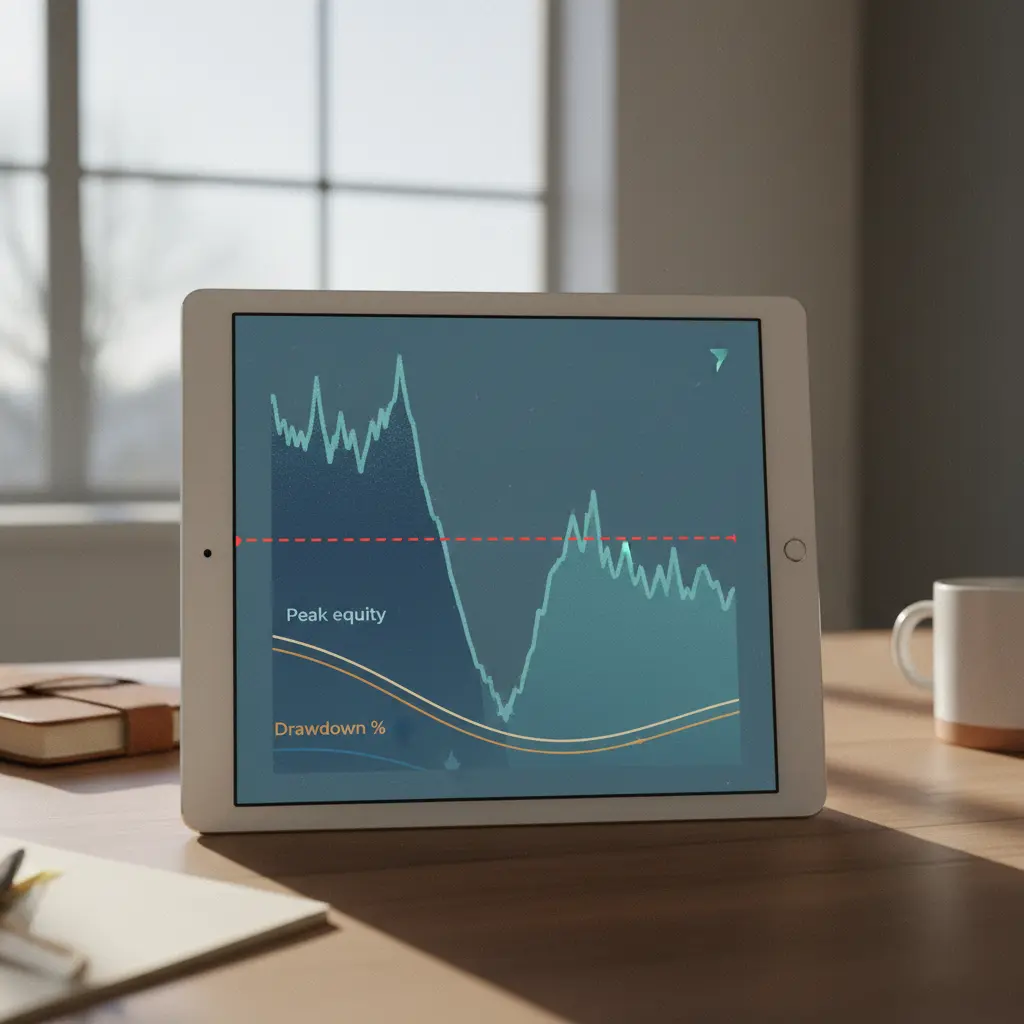
In simple terms, trading drawdown refers to the peak-to-trough decline in the value of your trading account during a specific period. It's measured from the highest point (equity high) to the lowest point (equity low) before a new equity high is reached. Drawdown isn't just about losing money; it's about the percentage of your capital that has been lost from its peak. For instance, a 10% drawdown means your account has lost 10% of its value from its highest point. A 50% drawdown is far more damaging and requires a much larger percentage gain to recover. A trader who experiences a 50% drawdown needs a 100% gain to simply get back to their starting capital. This compounding effect makes controlling drawdowns a top priority.
Consider two hypothetical traders, Alice and Bob, both starting with $10,000. Alice experiences a 20% drawdown, bringing her account to $8,000. To recover, she needs to gain $2,000, which is a 25% increase ($2,000 / $8,000). Bob, however, suffers a 50% drawdown, leaving him with $5,000. To recover, he needs to gain $5,000, requiring a 100% increase ($5,000 / $5,000). This illustrates why even small drawdowns, if unchecked, can snowball into much larger problems.
Key Metrics for Monitoring Drawdown
Effective drawdown control relies on monitoring specific metrics. The most fundamental is the percentage drawdown itself, as discussed. However, other metrics provide deeper insight. Maximum drawdown (MDD) is the single largest percentage drop from peak equity to the subsequent trough. This is a critical indicator of the worst-case scenario your trading strategy has produced historically or is currently experiencing. Another useful metric is average drawdown, which gives a sense of the typical loss experienced between profitable periods. Understanding the frequency and duration of drawdowns is also important. A strategy might have small drawdowns but experience them frequently, which can be mentally taxing and lead to poor decisions. Conversely, a strategy with infrequent but very deep drawdowns poses a significant risk of account wipeout. Regularly reviewing these numbers, perhaps weekly or monthly, provides a clear picture of your risk exposure.
Furthermore, the calmar ratio, which divides the annualized return by the maximum drawdown, offers a risk-adjusted performance measure. A higher Calmar ratio indicates better performance relative to the risk taken. For instance, a strategy returning 30% annually with a 15% MDD has a Calmar ratio of 2. A strategy returning 20% annually with a 5% MDD also has a Calmar ratio of 2. This highlights that absolute returns aren't the only story; how those returns were achieved matters greatly.
Setting Strict Risk Management Rules
The cornerstone of controlling drawdown is establishing and adhering to strict risk management rules. This isn't about avoiding losses altogether-that's impossible in trading-but about ensuring losses remain within predefined boundaries. A fundamental rule is setting a per-trade risk limit. This typically involves risking no more than 1-2% of your total trading capital on any single trade. If you have a $10,000 account, risking 1% means you are willing to lose a maximum of $100 per trade. This can be implemented by adjusting your position size based on your stop-loss level. For example, if you want to risk $100 on a trade and your stop-loss is 50 pips away, your position size would be calculated accordingly.
Another vital rule is the daily or weekly drawdown limit. This is a threshold beyond which you stop trading for the day or week. For example, you might decide that if your account equity drops by 3% in a single day, you will close all positions and refrain from further trading until the next day. Similarly, a weekly limit might be set at 5%. This prevents a single bad trading day from escalating into a larger, more sustained drawdown. Having these hard stops in place removes emotional decision-making during stressful periods.
Scenario 1: Per-Trade Risk Limit
Situation: A trader with a $25,000 account plans to risk 1.5% per trade.
Recommended Option: Calculate the maximum loss per trade as $25,000 0.015 = $375. Adjust position size so that if the stop-loss is hit, the loss does not exceed $375.
Alternative Option: Risk a fixed dollar amount ($300) without directly tying it to a percentage of capital.
What to Avoid: Risking $1,000 on a trade because the setup looks highly probable, irrespective of account size.
Explanation: The recommended option ensures consistent risk exposure regardless of account growth or slight fluctuations in stop-loss distances. The alternative is acceptable but less dynamic. Avoiding large, fixed risk amounts protects capital during inevitable losing streaks.
Scenario 2: Daily Drawdown Limit
Situation: A trader has a $5,000 account and a strict daily loss limit of 2%.
Recommended Option: Set a hard stop at $100 loss for the day ($5,000 0.02). Once this loss is reached, cease trading for the day.
Alternative Option: Take a break for a few hours if nearing the limit, then reassess if trading should continue.
What to Avoid: Chasing losses to recover the $100, often leading to further, larger losses.
Explanation: The recommended option forces a pause and prevents emotional trading. The alternative offers some flexibility but carries the risk of pushing past the limit. Revenge trading is a primary driver of significant drawdowns.
Stop-Loss Orders: Your First Line of Defense
Stop-loss orders are non-negotiable tools for managing risk and controlling drawdown. They are pre-set instructions to sell a security when it reaches a certain price, thereby limiting your potential loss on a trade. The key is to place stop-loss orders strategically, not arbitrarily. A stop-loss placed too close to your entry price might get triggered by normal market noise, forcing you out of a trade prematurely only for it to move in your favor later. Conversely, a stop-loss placed too far away increases your risk per trade and, consequently, your potential drawdown if the trade goes against you.
Consider technical analysis levels when setting stops. For example, if you buy a stock at $50 with strong support at $48, placing your stop-loss just below $48, say at $47.50, makes logical sense. This accounts for minor price fluctuations around the support level while still defining your maximum loss. The distance between your entry and your stop-loss directly impacts your position sizing. If you risk $100 and your stop-loss is 20 cents away, you can afford a larger position size than if your stop-loss is $2 away. This interplay between stop distance, risk per trade, and position size is fundamental to staying within your drawdown limits.
It's also important to understand different types of stop-loss orders. A standard stop-loss is static. A trailing stop-loss, however, adjusts upwards as the price moves in your favor, locking in profits and further protecting against reversals. For instance, if you set a trailing stop at 3% below the highest price reached since entry, and the price rises significantly, your stop moves up with it, ensuring that even if the price reverses, you exit with a profit or a smaller loss than otherwise.
Scenario 3: Technical Stop-Loss Placement
Situation: A trader buys EURUSD at 1.0850, identified a support level at 1.0800.
Recommended Option: Place a stop-loss order at 1.0790, allowing some buffer below the support.
Alternative Option: Place the stop-loss exactly at 1.0800.
What to Avoid: Placing the stop-loss at 1.0830, too close to the entry and within normal price volatility.
Explanation: The recommended option respects the technical support level while providing a necessary cushion. Placing it exactly at support risks being stopped out by minor fluctuations. Placing it too close ignores the potential for normal market noise.
Position Sizing: The Multiplier of Your Risk
Position sizing is arguably the most critical element in controlling drawdown, yet it's often misunderstood. It's the mechanism that translates your per-trade risk percentage and your stop-loss distance into a concrete number of shares, lots, or contracts. Incorrect position sizing can turn a small, manageable loss into a catastrophic one. If you consistently over-size your positions, a few losing trades can lead to substantial drawdowns. Conversely, proper position sizing ensures that each trade carries the same predefined risk, regardless of the perceived trade quality or market conditions.
The formula for calculating position size is generally: Position Size = (Account Equity Risk Percentage) / (Stop-Loss Distance in Pips Pip Value). For example, with a $10,000 account, a 1% risk ($100), and a stop-loss of 50 pips on a standard forex lot (worth $10 per pip): Position Size = ($10,000 0.01) / (50 pips $10/pip) = $100 / $500 = 0.2 lots. This means you would trade 0.2 standard lots (or 2 mini lots). If your stop-loss is hit, you lose exactly $100. If your stop-loss was 100 pips, your position size would be halved to 0.1 lots ($100 / $1000 = 0.1 lots) to maintain the $100 risk.
Failing to adjust position size as your account equity changes is a common mistake. If your account grows to $12,000, your 1% risk is now $120. If you continue to trade with the same position size calculated for $10,000, you are now risking more than 1% per trade. Similarly, if your account shrinks, your position size should also decrease to maintain the risk percentage. This dynamic adjustment is what truly controls risk and limits drawdown.
Scenario 4: Adjusting Position Size for Growth
Situation: A trader started with $10,000, risking 1% ($100) per trade, and used a position size of 0.2 lots on a 50-pip stop. Their account has grown to $12,000.
Recommended Option: Recalculate the risk percentage for the new equity: 1% of $12,000 = $120. If the stop-loss remains 50 pips, the new position size should be 0.24 lots ($120 / $500).
Alternative Option: Stick with the 0.2 lot size, meaning the risk per trade is now only $83.33 ($10,000 / $500), which is less than 1% but still acceptable risk.
What to Avoid: Continuing to use 0.2 lots and increasing the stop-loss distance to 60 pips to maintain the original $120 risk, as this weakens the trade's validity.
Explanation: The recommended option correctly scales the position size to match the increased capital and maintain the intended risk percentage. The alternative is safer in terms of dollar risk but deviates from the 1% target. Avoiding compromise on stop-loss placement is key.
Diversification and Portfolio Analysis
While not a direct per-trade drawdown control, diversifying your trading portfolio and performing regular portfolio analysis can significantly mitigate overall account drawdown. Diversification means not putting all your capital into a single asset class, trading strategy, or even a single correlated group of assets. For example, a forex trader might also trade futures, equities, or even cryptocurrency, using different, ideally uncorrelated, strategies for each. If one market or strategy enters a drawdown, others might be performing well, cushioning the blow to the total portfolio equity.
Portfolio analysis involves regularly reviewing the performance of all your trading activities collectively. This helps identify which strategies or assets are contributing most to drawdowns and which are performing well. Tools like a comprehensive trading journal are invaluable here. By categorizing trades by strategy, asset class, and market conditions, you can gain insights into performance drivers. A well-structured portfolio analysis can reveal if, for instance, your long-only equity strategy is consistently suffering during risk-off environments, suggesting the need for a hedging strategy or a short-biased strategy to balance it out. This strategic allocation reduces the likelihood of a single market event causing a massive hit to your overall capital.
Understanding correlations between assets is also part of effective diversification. If you trade two currency pairs that tend to move in the same direction, they offer little diversification benefit. Identifying and trading assets with low or negative correlations can create a more robust portfolio less susceptible to broad market downturns. This is where tools for portfolio analysis become essential.
Scenario 5: Diversifying Currency Pairs
Situation: A trader primarily trades EURUSD and GBPUSD, finding they often move together.
Recommended Option: Add a pair with low correlation, such as USDJPY or AUDUSD, to their trading portfolio.
Alternative Option: Focus on a single, well-understood currency pair and reduce overall exposure.
What to Avoid: Increasing the position size on both EURUSD and GBPUSD during a period where they are experiencing a correlated downtrend.
Explanation: Adding uncorrelated assets smooths out portfolio volatility. Focusing on one pair requires more stringent risk controls within that pair. Avoiding increasing exposure on highly correlated assets during a downturn is critical to prevent amplified losses.
Reviewing and Adjusting Your Strategy
Trading is not a static endeavor. Market conditions change, and your strategy might need adjustments to remain effective and control drawdown. Regularly reviewing your trading journal and performance metrics is paramount. If you notice a consistent increase in drawdown percentages or durations, it's a signal that something needs attention. This could mean your strategy is no longer suited to current market conditions, your execution is deteriorating, or your risk parameters are too loose.
For example, a trend-following strategy that worked well in a consistently trending market might struggle and generate larger drawdowns in a choppy, range-bound market. In such cases, you might need to either pause trading the strategy, adjust its parameters (e.g., tighten profit targets or widen stops temporarily), or even switch to a different strategy better suited for ranging conditions. This requires discipline and objective analysis, free from emotional attachment to a previously successful strategy. The key is to identify drawdowns not as failures, but as feedback mechanisms prompting necessary adaptations. Continuous learning and adaptation are hallmarks of traders who manage drawdown effectively. Explore our guide on trading journals to improve your review process.
Scenario 6: Strategy Drift During Market Changes
Situation: A breakout trading strategy has been consistently profitable but is now experiencing increasing losses and drawdowns.
Recommended Option: Analyze trading journal data to confirm the strategy is underperforming in the current market regime (e.g., range-bound). Consider pausing the strategy or switching to a mean-reversion approach temporarily.
Alternative Option: Widen stop-losses significantly on the breakout strategy, hoping to catch fewer false breakouts.
What to Avoid: Doubling down on the breakout strategy, increasing position sizes to recover losses, or forcing trades out of desperation.
Explanation: The recommended option involves adapting to market conditions based on data. Widening stops (alternative) increases risk per trade, contradicting the goal of drawdown control. Forcing trades and increasing risk (what to avoid) is a direct path to catastrophic drawdown.
The Importance of Psychological Resilience
Beyond the technical aspects, psychological resilience plays a huge role in managing drawdown. Experiencing losses and seeing your account equity decline can be emotionally taxing. Fear of further losses can lead to indecisive trading, missed opportunities, or premature profit-taking. Conversely, the desire to quickly recover losses (revenge trading) often leads to impulsive decisions and larger, riskier trades. Building mental toughness involves accepting that losses are an inherent part of trading and focusing on executing your plan consistently, regardless of recent outcomes.
Practicing mindfulness, maintaining a healthy lifestyle, and having a strong support system can bolster psychological resilience. It's also vital to have realistic expectations about trading. No strategy wins 100% of the time. Accepting this reality allows traders to approach each trade objectively, based on probabilities rather than emotions. Regularly reflecting on your psychological state during trading sessions, perhaps in your trading journal, can reveal patterns of emotional decision-making that contribute to excessive drawdowns. Understanding and managing your emotions is as critical as understanding technical indicators or risk management rules. For comprehensive strategies, explore our resources on risk management.
| Action Item | Status | Notes |
| Defined Per-Trade Risk Limit (e.g., 1-2%) | [ ] Not Started | Ensure position size calculation is accurate. |
| Set Daily/Weekly Drawdown Limit | [ ] Not Started | Implement hard stop for trading cessation. |
| Strategic Stop-Loss Placement | [ ] Not Started | Use technical levels; avoid noise. |
| Consistent Position Sizing | [ ] Not Started | Adjust for account equity changes. |
| Portfolio Diversification | [ ] Not Started | Assess asset/strategy correlations. |
| Regular Strategy Review | [ ] Not Started | Analyze journal for performance drift. |
| Psychological Preparedness | [ ] Not Started | Focus on plan execution, not outcomes. |
| Utilize a Trading Journal | [ ] Not Started | Record all trades and review performance. |
By systematically implementing these steps, traders can gain a significant edge in controlling drawdown and protecting their capital. It's a continuous process of learning, discipline, and adaptation.
Step-by-step trading workflow
Mastering Drawdown: Practical Steps to Protect Your Capital works better when the process is explicit. Use a short ordered checklist before you act.
- Define the setup and the exact reason it is on your radar.
- Measure the downside first, including stop distance and position size.
- Check whether the reward and market context still justify the trade.
- Log the plan so execution can be reviewed after the outcome is known.
Use the matching tool. The risk calculator helps turn this guide into a usable decision before the trade.
Related reading: trading risk management | risk reward ratio