

Achieving consistent daily success in forex trading hinges on rigorous discipline and robust risk management, not just market analysis. Developing a structured approach that prioritizes emotional control and adherence to a trading plan is crucial for navigating the volatile currency markets and avoiding common pitfalls that derail traders.
Building a Resilient Daily Trading Routine
A structured daily routine is the bedrock of disciplined forex trading. It's not about the number of trades you take, but the quality and consistency of your execution. Start by defining your trading session. Will you focus on the London open, the New York session, or the overlap? Committing to a specific timeframe helps you concentrate your efforts and avoid the temptation to constantly monitor the markets.
Your routine should include pre-market analysis, trade execution, and post-market review. Before the market opens, review economic calendars for high-impact news that could affect your chosen currency pairs. Identify potential setups based on your strategy. During your trading session, stick to your entry and exit criteria. Avoid impulsive decisions driven by fear or greed. Post-market, dedicate time to reviewing your trades, regardless of outcome. This is where learning happens.
Consider this scenario: A trader plans to trade EUR/USD during the London session. Their routine involves checking for any major Eurozone or US economic data releases at least an hour before the session starts. They identify a potential long setup based on a breakout above a key resistance level. They place their stop-loss order immediately after entry and set a realistic take-profit target. After closing the trade, they log the details and their emotional state in their trading journal.
Conversely, a trader without a routine might jump into trades randomly throughout the day, react to every news flicker, and exit trades prematurely due to anxiety. This often leads to inconsistent results and frustration.

The Unwavering Importance of a Trading Plan
A trading plan acts as your compass in the unpredictable forex market. It's a documented set of rules that dictate your trading activities. Without one, you're essentially navigating without a map, prone to making emotionally charged decisions. Your plan should clearly outline your trading strategy, including entry and exit rules, risk management parameters, and the currency pairs you'll trade.
Crucially, your plan must define your risk-per-trade. A common and effective guideline is to risk no more than 1-2% of your trading capital on any single trade. This ensures that even a string of losses won't decimate your account. For a $10,000 account, risking 1% means a maximum loss of $100 per trade. This small, controlled risk allows you to stay in the game long enough to execute your strategy and capture potential profits.
Scenario: A trader's plan specifies trading only the AUD/JPY pair and only taking trades that align with the longer-term trend identified on the daily chart. Entry triggers are based on moving average crossovers, and stops are placed below the recent swing low. A 1.5% risk rule is strictly enforced. If a trade hits its stop-loss, no further trades are taken that day, regardless of opportunity.
Alternative: A trader might have a more flexible plan allowing trades in any direction on multiple pairs, without strict risk limits. This often leads to over-leveraging and significant drawdowns.
What to avoid: Deviating from your entry and exit rules mid-trade based on gut feelings or news headlines. Ignoring your predefined risk-per-trade percentage.
Implementing Strict Risk Management Protocols
Risk management is the cornerstone of surviving and thriving in the forex market. It's not about avoiding losses entirely - that's impossible. It's about controlling the size of those losses so they don't jeopardize your ability to continue trading.
The most effective tool is the stop-loss order. Always place a stop-loss order when you enter a trade. This pre-determines the maximum amount you are willing to lose on that specific trade. For example, if you're trading EUR/USD and decide to risk $100 per trade, your stop-loss should be set at a level that, based on your position size, results in a $100 loss if triggered.
Position sizing is another critical component. It dictates how much of your capital you allocate to a trade, directly influencing the impact of your stop-loss. Tools like the PipsAlerts Position Sizing Calculator help you accurately determine the correct lot size based on your account balance, desired risk percentage, and stop-loss distance. Using this tool ensures you maintain your predetermined risk level across all trades.
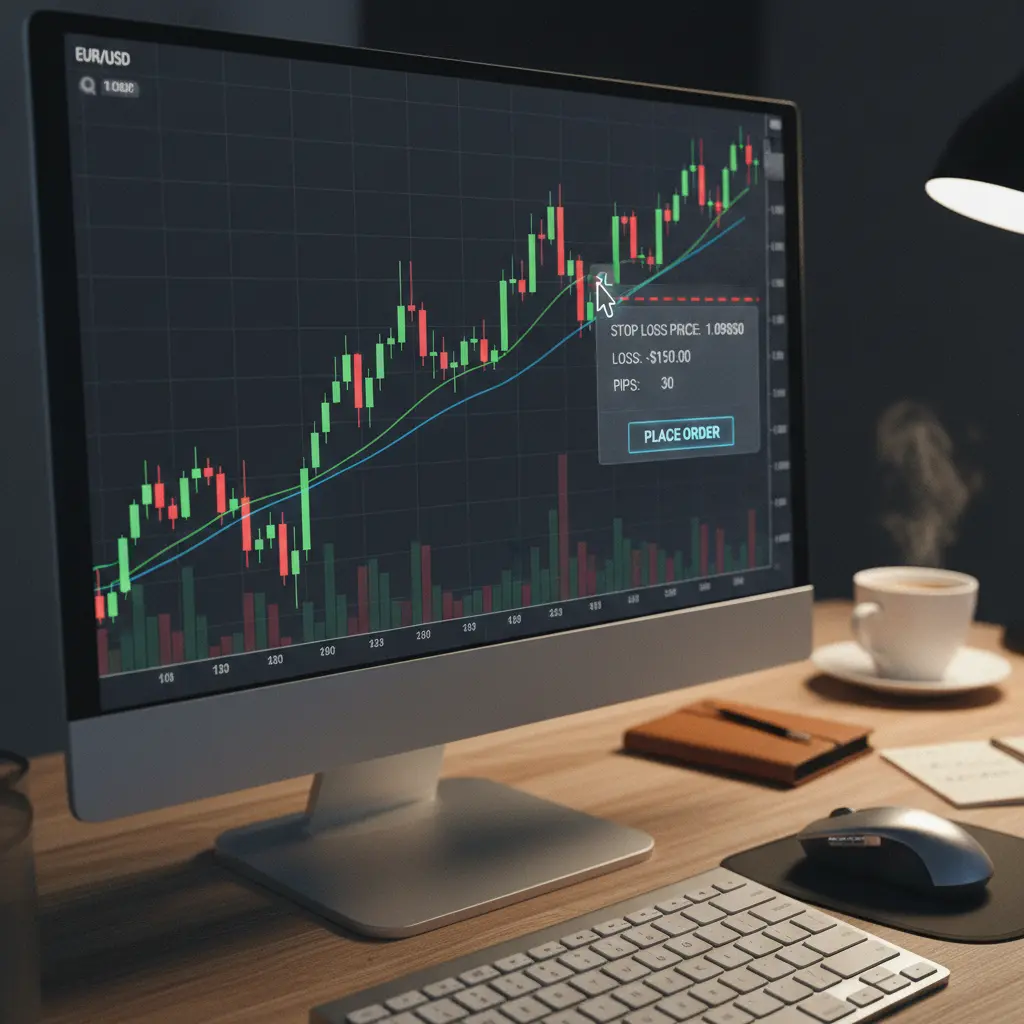
Scenario: A trader wants to buy USD/CAD at 1.3500. Their risk tolerance is 1% of their $5,000 account, which is $50. They determine their stop-loss should be at 1.3470. Using the position sizing calculator, they input $50 risk and a 30 pip stop-loss, which calculates the appropriate lot size (e.g., 0.17 lots).
Alternative: A trader might use a fixed number of pips for their stop-loss (e.g., always 50 pips) without considering account size or volatility, which can lead to inconsistent risk exposure.
What to avoid: Moving your stop-loss further away from your entry price to avoid taking a loss. Trading without a stop-loss order in place. Using excessive leverage that magnifies small losses into account-destroying events.
The Power of a Trading Journal
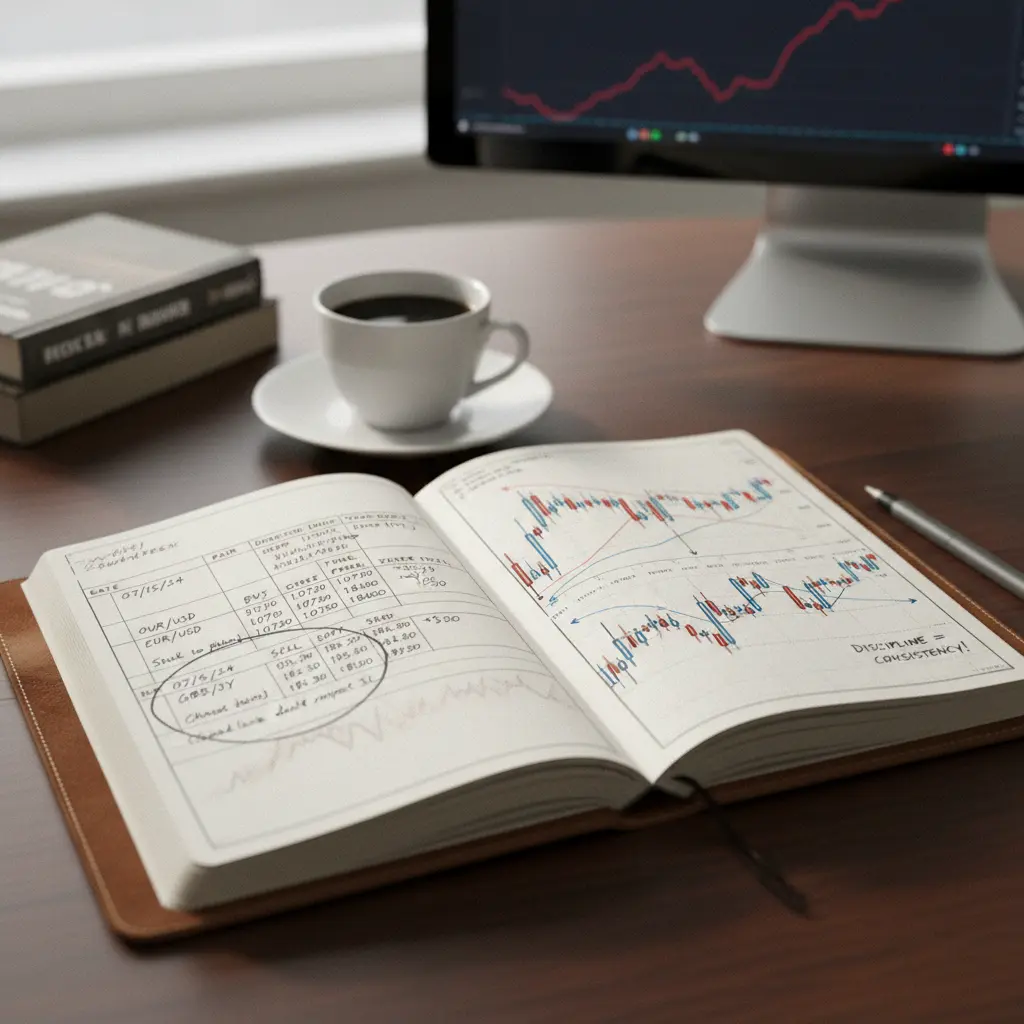
A trading journal is your personal record of every trade you make. It's indispensable for identifying patterns in your trading behavior, understanding what works, and pinpointing areas for improvement. Don't just record the entry and exit prices; log the rationale behind the trade, your emotional state before, during, and after the trade, and any external factors that might have influenced your decision.
A well-maintained journal allows you to analyze your performance objectively. You can identify which strategies are most profitable, which currency pairs suit your style, and what times of day yield the best results. This data-driven insight is far more valuable than relying on intuition alone. Regularly reviewing your journal is a critical step in the trading journal process.
Scenario: A trader logs a losing trade on GBP/USD. The journal entry notes: 'Entry: 1.2500, Exit: 1.2480, Stop: 1.2475. Rationale: Breakout of support. Emotion: Felt anxious due to recent news volatility. Review: Broke a trading rule by entering too early based on a false breakout. Next time, wait for confirmation candle.'
Alternative: A trader who only notes entry/exit and profit/loss without context. They might see they lost money but won't understand why or how to prevent it.
What to avoid: Skipping entries, being dishonest in your journal about your emotional state, or failing to review your journal regularly.
Controlling Emotions: The Discipline Factor
Emotions are often the biggest obstacle for daily forex traders. Fear of missing out (FOMO), greed, hope, and revenge trading can lead to disastrous decisions. Discipline is the ability to control these emotions and stick to your plan, even when it's difficult.
One way to build emotional resilience is through mindfulness and self-awareness. Recognize your emotional triggers. Are you prone to chasing trades when you feel you're missing out? Do you over-trade after a loss to 'get even'? Identifying these patterns is the first step. Then, implement pre-defined actions. If you feel the urge to revenge trade, step away from the screen for at least 15 minutes. Take a walk, do some deep breathing exercises.
Scenario: A trader experiences a significant loss on a trade due to unexpected market news. They feel a surge of anger and the urge to immediately re-enter the market to recoup losses. Instead of acting on impulse, they remember their plan's rule: if emotionally compromised after a loss, take a 30-minute break. They step away, clear their head, and return with a calmer perspective, deciding to stick to their pre-planned risk management for the next day.
Alternative: The trader immediately jumps back in with a larger position size, hoping for a quick recovery. This often leads to compounding losses.
What to avoid: Trading when angry, frustrated, or overly excited. Letting a single bad trade dictate your entire trading day.
Leveraging Market News Wisely
Daily forex trading often involves managing positions around significant economic events. While volatility increases, it also presents opportunities. The key is to approach these events with preparation and discipline, not speculation.
Understand the potential impact of upcoming news releases on your chosen currency pairs. High-impact events like Non-Farm Payrolls (US), CPI figures (various countries), or central bank interest rate decisions can cause sharp price movements. Your trading plan should dictate how you handle these events. Some traders prefer to stay out of the market an hour before and after major news. Others may look for specific patterns that emerge post-news, but always with clearly defined risk.
Scenario: A trader is watching USD/JPY ahead of the Bank of Japan interest rate decision. Their plan states: 'Avoid trading USD/JPY 30 minutes before and after BoJ announcements.' They observe the price action from a distance, noting the increased volatility but refrain from entering a trade until the market has settled and a clear direction emerges post-announcement, adhering to their strategy.
Alternative: A trader sees the volatility and tries to scalp quick profits from the choppy price action, risking significant capital without a well-defined strategy for news trading.
What to avoid: Trading solely based on news headlines without understanding the data or its market implications. Assuming a news release will always move the market in a predictable direction.
Adapting Your Strategy for Daily Consistency
While discipline is about sticking to your plan, flexibility within that plan is also vital. The forex market evolves, and what worked yesterday might need slight adjustments today. This doesn't mean changing your core strategy impulsively but rather refining your approach based on performance data from your trading journal and market conditions.
Consider incorporating different timeframes for analysis. You might use daily charts to identify the overall trend but focus on 15-minute or 1-hour charts for precise entry and exit signals. This multi-timeframe analysis provides a broader perspective and helps confirm your trading decisions.
Scenario: A trader notices their strategy, which relies on identifying support and resistance levels on the 1-hour chart, is producing fewer high-probability setups. Reviewing their journal, they see that many of their recent trades were triggered by volatility spikes just before the US session open. They decide to incorporate a tighter confirmation signal on the 15-minute chart for entries during that specific hour, improving their win rate without abandoning their core strategy.
Alternative: The trader continues using the exact same entry criteria despite declining setup quality, hoping for a return to previous performance.
What to avoid: Constantly changing your strategy based on one or two losing trades. Overcomplicating your trading system with too many indicators or rules.
This disciplined approach, combining a solid routine, a clear plan, strict risk controls, meticulous journaling, emotional mastery, and adaptive strategy refinement, is the path to consistent daily trading in the forex market. It requires patience and dedication, but the rewards of stable growth and capital preservation are well worth the effort.
Explore more on how to enhance your trading: Understanding Forex Risk Management and Mastering Your Trading Journal.
| Trading Discipline Component | Importance | Actionable Steps | Potential Pitfalls |
| Daily Routine | Ensures focus and consistency | Define trading hours, pre/post-market tasks | Trading outside defined hours, skipping reviews |
| Trading Plan | Provides clear rules and objectives | Document strategy, risk/reward, currency pairs | Deviating from rules, no clear exit strategy |
| Risk Management | Protects capital, limits losses | Use stop-losses, position sizing, 1-2% rule | Over-leveraging, no stop-loss, chasing losses |
| Trading Journal | Enables performance analysis | Log all trades with context, review regularly | Incomplete entries, no analysis, dishonest records |
| Emotional Control | Prevents impulsive decisions | Identify triggers, take breaks, practice mindfulness | Revenge trading, FOMO, greed-driven trades |
| News Handling | Navigates volatility safely | Understand impact, pre-plan reactions | Overtrading news, speculative bets |
| Strategy Adaptation | Maintains effectiveness over time | Refine based on data, use multi-timeframes | Impulsive strategy changes, overcomplication |
Step-by-step trading workflow
Master Daily Forex Trading: Discipline Strategies for Consistent Growth works better when the process is explicit. Use a short ordered checklist before you act.
- Define the setup and the exact reason it is on your radar.
- Measure the downside first, including stop distance and position size.
- Check whether the reward and market context still justify the trade.
- Log the plan so execution can be reviewed after the outcome is known.
Related reading: trading risk management