

Forex trading offers opportunities for profit but requires a solid understanding of its fundamentals before risking capital. This guide breaks down the core concepts new traders need to grasp, focusing on practical application and risk awareness to build a strong foundation.
Understanding the Forex Market
The foreign exchange market, or forex, is the largest and most liquid financial market globally, where currencies are traded. Unlike stock exchanges, forex operates 24 hours a day, five days a week, across multiple time zones. Major currency pairs form the backbone of this market. For instance, EUR/USD represents the exchange rate between the Euro and the US Dollar. When you trade EUR/USD, you're essentially betting on whether the Euro will strengthen or weaken against the Dollar. Understanding these base and quote currencies is crucial. The market's decentralized nature means trades happen over-the-counter (OTC) through electronic networks connecting banks, brokers, and institutions worldwide. This global reach and constant activity create unique trading opportunities but also necessitate strict risk management.

Key Terminology Every New Trader Must Know
Before placing your first trade, familiarizing yourself with forex terminology is non-negotiable. A pip (percentage in point) is the smallest unit of price movement for currency pairs. For most pairs, it's the fourth decimal place; for JPY pairs, it's the second. Understanding pip value helps calculate potential profits and losses. Leverage allows you to control a larger position with a smaller amount of capital. While it can amplify profits, it equally magnifies losses, making it a double-edged sword for beginners. Margin is the deposit required to open and maintain a leveraged trading position. Brokers set margin requirements, often expressed as a percentage of the total trade value. Spread is the difference between the bid (sell) price and the ask (buy) price, representing a broker's commission. A tighter spread is generally better for traders. Knowing these terms helps demystify trading platforms and execute strategies effectively.
Choosing the Right Currency Pairs
New traders often gravitate towards major currency pairs due to their high liquidity and tighter spreads. These pairs involve the US Dollar and other major currencies like the Euro (EUR/USD), Japanese Yen (USD/JPY), and British Pound (GBP/USD). The EUR/USD is the most heavily traded pair, often exhibiting lower volatility compared to some others. The USD/JPY can offer significant opportunities but may experience more rapid price swings. Cross-currency pairs, like EUR/GBP, involve two currencies that do not include the US Dollar. They can be more volatile and have wider spreads. Exotic pairs, such as USD/TRY (US Dollar vs. Turkish Lira), involve one major currency and one from an emerging economy; these are typically the most volatile with the widest spreads and should be approached with extreme caution by beginners.
Here's a look at common pair types:
| Pair Type | Examples | Typical Spread | Volatility Level | Best For |
|---|---|---|---|---|
| Majors | EUR/USD, GBP/USD, USD/JPY | Low (1-3 pips) | Moderate | Beginners seeking stability |
| Minors (Crosses) | EUR/GBP, AUD/CAD | Moderate (3-7 pips) | Moderate to High | Intermediate traders |
| Exotics | USD/MXN, EUR/PLN | High (10+ pips) | Very High | Experienced traders, high risk tolerance |
Essential Tools for Forex Trading
Success in forex trading isn't just about market knowledge; it's also about leveraging the right tools. A reliable trading platform is your gateway to the market, offering charting capabilities, order execution, and news feeds. MetaTrader 4 (MT4) and MetaTrader 5 (MT5) are industry standards, widely used by brokers and traders. A trading journal is perhaps the most critical tool for long-term growth. It's not just a record of trades but a place to analyze your performance, identify patterns in your decision-making, and document lessons learned. Websites like Investing.com or TradingView provide real-time market data, economic calendars, and charting tools. Understanding how to use an economic calendar is vital, as economic news releases can cause significant market volatility. Analyzing your trades systematically in a journal, perhaps using our guide on trading journal benefits, can prevent repeating costly mistakes.
Risk Management: Protecting Your Capital
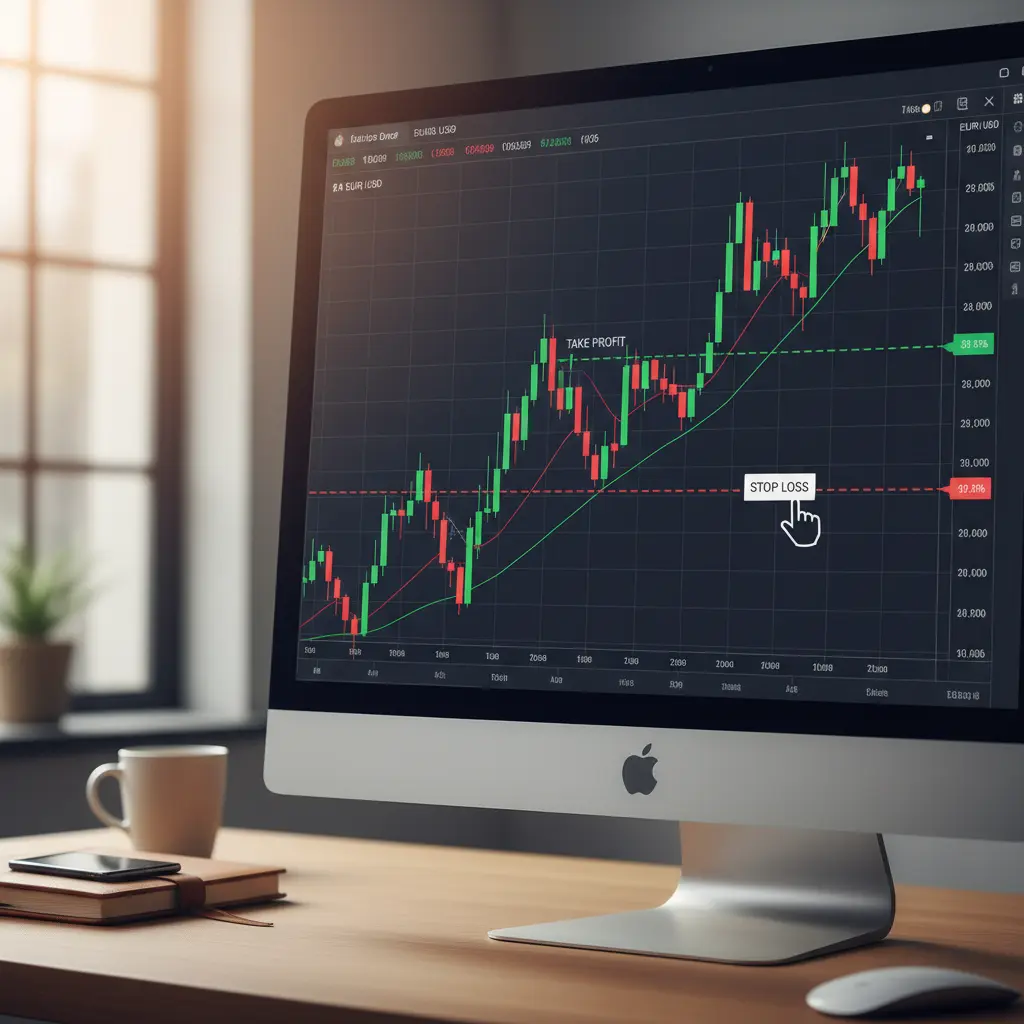
The most crucial aspect of forex trading for newcomers is robust risk management. Never trade with money you cannot afford to lose. A common rule is to risk no more than 1-2% of your trading capital on any single trade. This can be achieved using stop-loss orders, which automatically close a trade when it reaches a predetermined loss level. For example, if you buy EUR/USD at 1.1000 and set a stop-loss at 1.0950, you limit your potential loss to 50 pips. This is a fundamental step for safeguarding your account. Another strategy is position sizing; calculating how much to trade based on your stop-loss distance and your risk percentage. If you risk 1% of a $10,000 account (which is $100) and your stop-loss is 50 pips away, you'd calculate the trade size that makes a 50-pip move equal to $100. Always know your maximum potential loss before entering a trade. You can learn more about implementing these strategies in our risk management strategies guide.
Scenario: Volatile News Event
Situation: You are holding a long position on GBP/USD. A surprise interest rate cut announcement is imminent, known to cause sharp reversals.
Recommended Option: Exit the position before the announcement or place a very tight stop-loss, accepting a small potential loss for capital preservation.
Alternative Option: Significantly reduce your position size to minimize potential exposure.
What to Avoid: Holding the full position with a wide stop-loss, hoping the market moves in your favor despite the expected volatility.
Explanation: Unexpected news events are prime drivers of volatility. Protecting capital by limiting exposure or exiting the trade is paramount when such events loom.
Scenario: Trading a New Pair
Situation: You are interested in trading USD/CAD, a pair you haven't traded before, and it's currently trending.
Recommended Option: Start with a very small position size and a wide stop-loss, focusing on understanding the pair's behavior during different market conditions.
Alternative Option: Wait for the pair to show clear, consistent patterns over several trading days before committing capital.
What to Avoid: Applying the same risk parameters or trading psychology used for EUR/USD without studying USD/CAD's specific characteristics and volatility.
Explanation: Each currency pair has unique trading dynamics. New pairs require careful observation and adjusted risk before full commitment.
Scenario: Leverage Misuse
Situation: A new trader sees high leverage (1:200) offered by a broker and wants to maximize potential profits on a small account.
Recommended Option: Use leverage conservatively, perhaps only 1:10 or 1:20, and focus on proper position sizing that aligns with a 1-2% risk rule.
Alternative Option: Use leverage to only increase the size of trades that have a significantly higher than usual probability of success, with strict stop-losses.
What to Avoid: Using maximum leverage to open large positions that, even with small price movements against you, can wipe out the entire account.
Explanation: High leverage amplifies both gains and losses. It's a tool best used with extreme discipline and a deep understanding of its risks.
Developing a Trading Plan
A trading plan acts as your strategic roadmap. It should outline your trading goals, risk tolerance, preferred trading style (e.g., day trading, swing trading), the markets you'll trade, and the specific criteria for entering and exiting trades. For instance, a day trader might look for specific candlestick patterns on 15-minute charts for entry, with a target profit of 30 pips and a stop-loss of 15 pips. A swing trader might focus on daily charts, identifying support and resistance levels, aiming for trades that last several days. Crucially, your plan must incorporate your risk management rules, such as the 1-2% risk per trade. Regularly reviewing and refining your trading plan based on your performance data from your trading journal is essential for continuous improvement. Without a plan, trading often becomes reactive and emotionally driven, a common pitfall for new traders.
Scenario: Defining Entry/Exit Criteria
Situation: You've identified EUR/JPY as a pair to trade, but you're unsure when to enter and exit.
Recommended Option: Define clear entry criteria, such as a break above a key resistance level with increased volume, and exit criteria including a trailing stop-loss to capture profits as the trade moves favorably.
Alternative Option: Use a combination of technical indicators (e.g., RSI overbought/oversold levels) for entry and a fixed percentage of your target profit as a stop-loss.
What to Avoid: Entering trades based on gut feeling or entering after a significant price move has already occurred without confirmation.
Explanation: Objective entry and exit rules remove emotional bias and provide a consistent approach to trade execution.
Scenario: Setting Realistic Profit Targets
Situation: You've entered a profitable trade on AUD/NZD, and it's moving towards your initial profit target.
Recommended Option: Let winners run by using a trailing stop-loss or by partially closing the position and moving the stop-loss to breakeven, allowing further upside potential.
Alternative Option: Secure a portion of the profit at the first target and then trail the stop-loss on the remainder of the position.
What to Avoid: Closing the entire position immediately upon reaching the first target, especially if market conditions suggest further continuation.
Explanation: Maximizing profitable trades, while managing risk, is key to long-term profitability. Don't leave potential gains on the table unnecessarily.
Continuous Learning and Adaptation
The forex market is dynamic. What works today might need adjustments tomorrow. Commit to ongoing learning. This includes staying updated on market news, understanding geopolitical events that impact currencies, and continually refining your trading strategies. Regularly analyze your trade log within your trading journal tool to identify recurring errors or successful patterns. Perhaps you consistently lose money when trading around major economic data releases; the journal will highlight this. Or maybe you find that a particular indicator setup has a high win rate for you. PipsAlerts provides resources like our comprehensive risk management guides and portfolio analysis insights to support your journey. Patience and discipline are your greatest allies. Avoid chasing losses or deviating from your trading plan based on emotion.
Scenario: Analyzing Losing Trades
Situation: You review your trading journal and notice a pattern of losing trades on a specific day of the week.
Recommended Option: Investigate the market conditions or news events prevalent on that day of the week that might be causing your losses. Adjust your trading schedule or strategy accordingly.
Alternative Option: Focus on the common technical setups or indicators used in those losing trades to see if they were misapplied.
What to Avoid: Ignoring the pattern and continuing to trade on that day without understanding the root cause.
Explanation: Identifying and understanding losing patterns is as important as recognizing winning ones to improve your overall trading performance.
Scenario: Adapting to Market Regimes
Situation: You've been successfully trading trending markets, but the forex market enters a period of consolidation and sideways movement.
Recommended Option: Adapt your strategy to suit range-bound conditions, perhaps by looking for trades at support and resistance levels or pausing trading until clearer trends emerge.
Alternative Option: Focus on currency pairs that are currently exhibiting stronger trends, even if they are not your usual preference.
What to Avoid: Forcing a trending strategy onto a consolidating market, leading to multiple small losses.
Explanation: Market conditions change constantly. Successful traders adapt their approach to align with the prevailing environment.
Scenario: Over-Leveraging During Choppy Markets
Situation: The market is experiencing high volatility with frequent, small price swings in both directions (choppy market).
Recommended Option: Reduce leverage and position size significantly. Use tighter stop-losses to avoid being stopped out by minor fluctuations.
Alternative Option: Consider trading less frequently during these choppy periods and wait for more defined trends to emerge.
What to Avoid: Using high leverage to try and profit from the small swings, as this significantly increases the risk of margin calls or rapid account depletion.
Explanation: Choppy markets are treacherous. Increased caution with leverage and position size is essential to preserve capital.
Step-by-step trading workflow
Starting in Forex: A New Trader's Practical Guide works better when the process is explicit. Use a short ordered checklist before you act.
- Define the setup and the exact reason it is on your radar.
- Measure the downside first, including stop distance and position size.
- Check whether the reward and market context still justify the trade.
- Log the plan so execution can be reviewed after the outcome is known.