
Most traders collect far more data than they actually need, which ultimately hurts their trading performance. This article will guide you on how to cut through the noise and focus on the few, crucial data points that genuinely impact your results, enabling more effective decision-making and strategy refinement.
The Illusion of Insight: Too Much Data, Too Little Clarity
It's a common trap for new traders, and even experienced ones sometimes fall back into it. You start a trading journal, excited to capture every detail. You log the exact time of entry, the specific price, the tick volume, the number of shares or lots, the broker's server time, the news sentiment score, the moon phase, and perhaps even how much coffee you had that morning. While the intention is to gain a comprehensive understanding, this deluge of information often creates a paralyzing effect. Instead of revealing clear patterns, it blurs the lines, making it harder to see what's truly working and what's not. The sheer volume demands significant time for analysis, time that could be better spent on active trading, research, or refining core strategies. This over-collection is fueled by a misunderstanding of correlation versus causation; just because you logged a piece of data doesn't mean it's causing your trading outcome.
Consider Sarah, a day trader who religiously logged over 50 data points per trade. She spent hours every weekend reviewing spreadsheets, trying to find a 'magic' combination. Despite this exhaustive effort, her win rate remained stagnant. She was so bogged down by analyzing irrelevant data like the specific exchange rate at the moment of a news release or the color of her shirt that day, she missed the simple recurring pattern in her entry signals that actually led to her few profitable trades.
Identifying Your Core Trading Metrics
The key to effective trading data collection lies in focusing on metrics directly tied to your strategy's performance and your personal trading psychology. These are the variables that show you if your entry/exit rules are sound, if your risk management is appropriate, and if your emotional state is sabotaging your decisions. We're talking about data that influences P&L and directly informs strategy adjustments. Think about the primary drivers of profit and loss: the quality of your entries, the effectiveness of your exits, and the size of your risk per trade. Everything else often becomes noise.
A good starting point is to ask yourself: 'If I could only track three things about each trade, what would they be?' For many, this might be the entry price, exit price, and stop-loss level. But as you refine your strategy, more specific metrics become critical. For a breakout strategy, the volume on the breakout candle is vital. For a trend-following strategy, the moving average crossover signal might be your key. For scalpers, the slippage or spread might be more important than the overall market sentiment.
Essential Metrics for Most Traders:
- Entry & Exit Points: The bedrock of any trade analysis.
- Stop-Loss Level: Crucial for risk management.
- Profit Target: Helps assess potential reward.
- Trade Outcome (Win/Loss): The fundamental result.
- Position Size: Directly impacts risk and reward per trade.
- Risk Amount ($): The actual capital risked on the trade.
- Reward Amount ($): The actual capital gained.
- Strategy Name/Identifier: To group similar trade setups.
This ordered list provides a solid foundation. You can find more about building a robust trading journal in our guide on building a trading journal.
Scenario Analysis: What Data Is Actually Telling You?
Let's look at how focusing on key metrics can change your perspective: Let's look at how focusing on key metrics can change your perspective:
Scenario 1: The Overly Specific News Tracker
- Situation: A trader logs the precise time of every economic release (e.g., Non-Farm Payrolls, CPI) and the market's reaction within 5 minutes.
- Recommended Option: Focus on whether the trade setup occurred despite or because of the news event, and how effectively the trade was managed. Log the news event type (e.g., 'major', 'minor') as a variable, not its timestamp.
- Alternative Option: Track only if the news event caused significant volatility that invalidated their setup.
- What To Avoid: Logging granular time-series data of price action immediately post-news.
- Explanation: Reacting to every micro-movement around news is usually detrimental. Focus on how the news impacted your strategy's logic, not the intraday price chaos.
Scenario 2: The 'Feeling' Trader
- Situation: A trader relies heavily on subjective feelings - 'felt bullish', 'had a gut feeling'.
- Recommended Option: Replace 'feelings' with objective entry criteria based on technical indicators or chart patterns. Quantify the 'feeling' by noting specific chart formations or indicator signals that preceded the trade.
- Alternative Option: Assign a 'confidence score' (1-10) to each trade, which correlates to the objective setup.
- What To Avoid: Logging 'gut feeling' as a primary reason for entry.
- Explanation: Subjectivity leads to inconsistency. Objective criteria, even if initially based on a strong intuition, can be tested and refined. This relates to our risk management principles.
Scenario 3: The Indicator Overload
- Situation: A trader uses 8 different technical indicators on their charts and logs the status of each for every trade.
- Recommended Option: Identify 1-2 core indicators that consistently align with winning trades and focus data collection on their signals.
- Alternative Option: Track which combination of indicators most frequently precedes a profitable outcome.
- What To Avoid: Tracking every indicator's value at the moment of entry/exit without a clear hypothesis on its impact.
- Explanation: Too many indicators create conflicting signals and analysis paralysis. Simplifying to a core set linked to your strategy is more effective.
When Less Data is More: Practical Application
The principle of 'less is more' is highly applicable to trading data. Instead of creating a sprawling database, focus on a curated set of data points that allow you to answer critical questions about your trading performance. For example, if you're testing a moving average crossover strategy, don't worry about the intraday price volatility of a minor currency pair. Instead, rigorously track:
- The specific moving averages used (e.g., 50-day and 200-day).
- The signal generation point (e.g., price crossing above 200-day MA when 50-day MA is also rising).
- The stop-loss placement relative to recent price action.
- The outcome of the trade (e.g., hit profit target, hit stop-loss, trailing stop activated).
- The timeframe of the trade.
This focused approach allows you to quickly see if your chosen moving averages are effective, if your entry signals are producing profitable trends, and if your risk parameters are appropriate for this strategy. If you find that trades generated by this strategy consistently hit their stop-loss quickly, you can examine the entry criteria or the stop-loss placement with targeted data. This is far more efficient than sifting through hundreds of irrelevant data points.
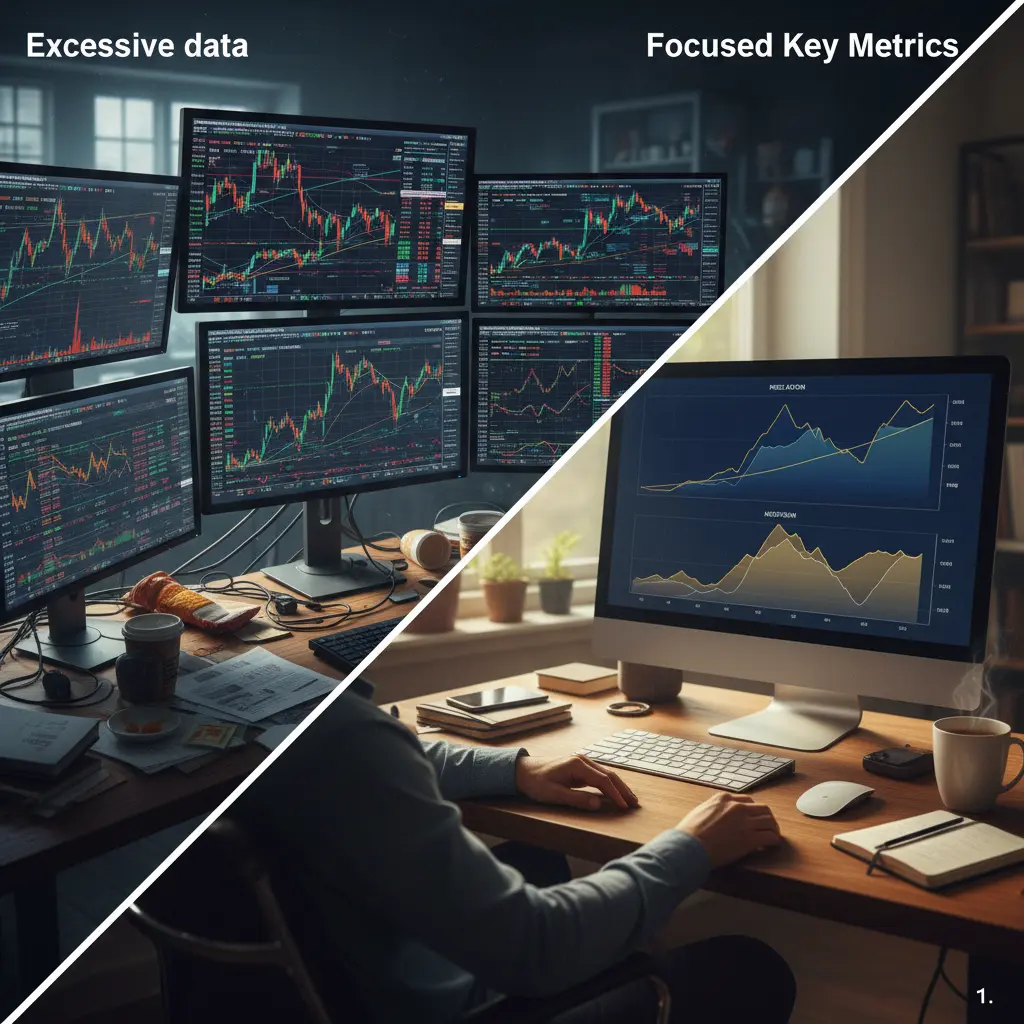
Consider the impact of focusing on just a few key metrics:
The Trade-Offs: Gaining Focus, Potentially Losing Nuance
It's important to acknowledge that by intentionally limiting the data you track, you are making a trade-off. You are sacrificing the potential to uncover extremely niche correlations or subtle patterns that might exist within a massive dataset. However, the overwhelming majority of traders will never reach the point where this level of granular detail becomes beneficial. The cost of collecting and analyzing such vast amounts of data in terms of time, mental energy, and potential for misinterpretation far outweighs the slim chance of finding a truly actionable, yet obscure, insight.
The risk here is focusing so narrowly that you miss a developing trend that impacts your strategy indirectly. For example, a trader focused only on price and volume might miss a critical shift in market sentiment driven by geopolitical events that, while not directly impacting their setup's trigger, are influencing overall market direction and therefore the probability of their trade succeeding.
Scenario 4: The Short-Term Focus Trap
- Situation: A swing trader focuses only on their entry/exit prices and daily P&L, ignoring longer-term trend indicators.
- Recommended Option: Add a metric for the longer-term trend direction (e.g., 'bullish', 'bearish', 'neutral' based on weekly/monthly charts) to their journal.
- Alternative Option: Track the correlation between their trade direction and the prevailing weekly trend.
- What To Avoid: Completely disregarding context beyond the immediate trading session.
- Explanation: Fighting the long-term trend significantly reduces win rates, even with perfect short-term execution.
Scenario 5: The Slippage Blind Spot
- Situation: An automated trader using an ECN broker notices a slight underperformance compared to backtested results.
- Recommended Option: Start logging the exact fill price versus the intended order price to quantify slippage.
- Alternative Option: Track slippage per instrument and time of day.
- What To Avoid: Assuming P&L discrepancies are solely due to strategy flaws without checking execution costs.
- Explanation: Consistent slippage, especially in volatile markets or during peak hours, can eat into profits and make even a profitable strategy appear unprofitable. This is a key aspect of execution quality.
Leveraging Tools for Smarter Data Tracking
Fortunately, modern trading platforms and journal software are designed to help you manage this. Many platforms automatically log core trade data like entry/exit prices, volume, and timestamp. The challenge then becomes how you augment this with specific strategy-related data and psychological insights. Utilizing tools like PipsAlerts' own trading journal software can streamline this process. These tools allow for custom fields and categorization, enabling you to tag trades with specific strategy names, market conditions, or even pre-trade checklists.
When selecting a tool, consider its ability to filter and sort your trades based on the specific metrics you've identified as critical. A good journal should allow you to quickly pull up all trades executed using your 'Trend Following' strategy in bullish market conditions, for example. This level of detail and filtering is impossible with manual spreadsheets unless they are meticulously designed, which itself requires understanding what data is important.
Data Analysis That Drives Action
The ultimate goal of tracking data isn't just to have records; it's to drive actionable improvements. If your analysis of even your focused dataset reveals a consistent pattern, you need to act. For instance, if you notice that 70% of your 'Trend Following' trades lose money when the 10-day moving average is below the 50-day moving average, this is a powerful insight. The action isn't to try and dissect every tiny variable of those losing trades. The action is to refine your strategy rules:
- Option 1: Add a rule to only take 'Trend Following' trades when the 10-day MA is above the 50-day MA.
- Option 2: Develop a different strategy for when the 10-day MA is below the 50-day MA.
- What To Avoid: Continuing to trade the strategy under the same conditions, hoping for a different outcome.
- Explanation: This directly addresses a pattern identified in your focused data, making your trading rules more robust and less prone to costly errors. This type of adjustment is central to effective risk management and strategy evolution.
This proactive approach, informed by targeted data, is how you move from simply recording trades to actively improving your trading performance. It's about building a feedback loop where your data analysis directly leads to specific, measurable changes in your trading approach.
Scenario 6: The Inconsistent Stop-Loss Application
- Situation: A trader sets stop-losses but sometimes moves them further away when a trade goes against them, or exits profitable trades too early.
- Recommended Option: Log the initial stop-loss placement and the final exit price for every trade. Also, add a simple boolean field: 'Stop-Loss Hit' (Yes/No).
- Alternative Option: Analyze the P&L difference between trades where the initial stop was hit versus trades where it was manually moved or exited early.
- What To Avoid: Not differentiating between trades that reached their pre-defined risk limit and those that were managed subjectively.
- Explanation: This highlights whether adhering to the initial stop-loss would have been more profitable, directly addressing a common psychological pitfall. Understanding your performance when you stick to rules versus when you deviate is critical.
By adopting a disciplined approach to data collection and analysis, focusing only on what truly influences your P&L and psychology, you can transform your trading journal from a data repository into a powerful tool for continuous improvement. This clarity helps you make better trading decisions and build a more resilient trading business.
Decision checkpoints
Stop Drowning in Data: Focus on What Matters for Trading Success benefits from clear checkpoints. Use a simple decision table to compare conditions before you execute.
| Situation | Best action | What to avoid |
|---|---|---|
| Calm conditions | Use standard size with planned stop | Adding size without a stronger edge |
| High volatility | Reduce size and widen the review lens | Forcing normal size into unstable price action |
| Post-trade review | Log execution quality and risk accuracy | Judging the trade only by outcome |
Start with the cluster hub. Read trading journal guides first if you want the broader workflow behind this topic.
Related reading: how to use a trading journal | day trading journal review