
Portfolio concentration risk occurs when a significant portion of your trading capital is tied up in a single asset, sector, or correlated group of assets, magnifying potential losses if that specific investment performs poorly. This imbalance can leave your overall portfolio vulnerable to the fortunes of a narrow market segment, dramatically increasing your exposure beyond what a diversified approach would dictate.
What Exactly Is Concentration Risk?
In simple terms, it's putting too many of your trading eggs in one or a few baskets. Imagine a trader who allocates 70% of their capital to tech stocks. If the tech sector faces a downturn, like the dot-com bubble burst or a sudden regulatory change, that trader's portfolio will suffer disproportionately compared to someone holding a wider mix of industries. This isn't just about individual stock picks; it can also apply to sectors (like energy or biotech), geographical regions (e.g., all investments in emerging markets), or even specific market events that affect many assets simultaneously. The core issue is a lack of broad market exposure, leading to amplified volatility and potential for substantial downside.
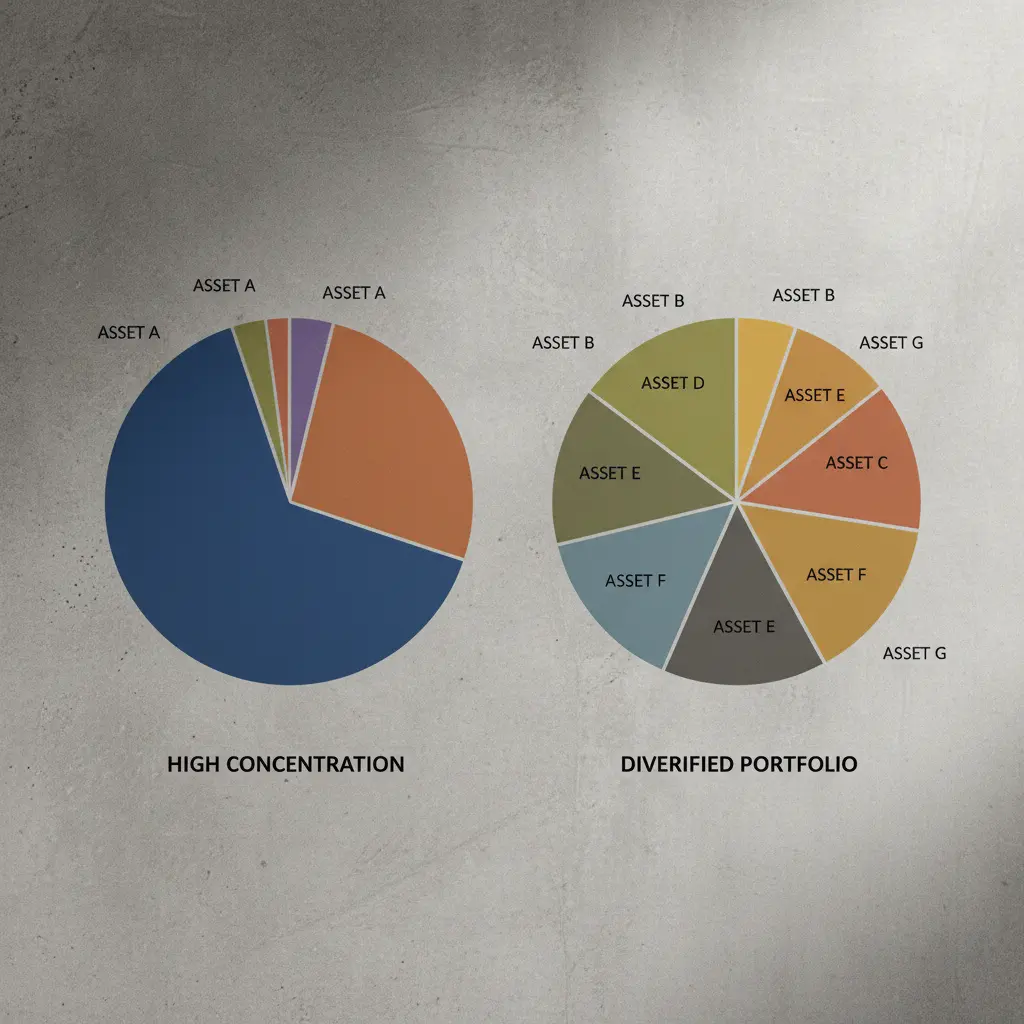
For instance, consider a trader heavily invested in gold miners. While this might seem prudent during inflationary periods, a sudden spike in interest rates could lead to a sharp decline in gold prices and, by extension, the value of those mining stocks. This single-factor dependency is the hallmark of concentration risk. It means the success of your entire trading endeavor hinges on the performance of a very limited set of factors.
Identifying Concentration Risk in Your Portfolio
The first step to managing concentration risk is recognizing it. This involves a thorough review of your current holdings. Many traders overlook this by simply tracking individual trade performance without assessing the aggregate exposure. A practical approach involves categorizing your assets by sector, industry, geographical location, and even asset class. Tools like a trading journal with detailed tagging features can be invaluable here. For example, if your journal shows that 50% of your open positions are in renewable energy stocks, you're likely facing concentration risk in that sector. Another common scenario is holding multiple large-cap tech stocks that, while seemingly different, are highly correlated in their market movements.
Let's look at a trader's portfolio:
- 50% in Apple (AAPL)
- 30% in Microsoft (MSFT)
- 10% in Google (GOOGL)
- 10% in various ETFs not related to tech
While these are different companies, they are all major players in the tech sector. A negative event impacting big tech, such as increased antitrust scrutiny or a shift in consumer spending away from digital services, would hit all three major holdings hard. This situation, even with distinct company names, represents significant concentration risk within the technology sector.
Conversely, a portfolio might be concentrated not by sector but by a single catalyst. Consider a trader who bought shares in several pharmaceutical companies solely because they were all developing a similar groundbreaking drug. If clinical trials fail for that drug, all those investments could plummet simultaneously, regardless of the companies' other operations.
The Impact of Concentration Risk on Trading
Concentration risk amplifies both potential gains and, more importantly for risk management, potential losses. When your capital is focused, a positive move in your chosen asset can lead to exceptional returns. However, the downside is far more perilous. A significant drop in the concentrated asset can wipe out a substantial portion of your capital, potentially taking months or even years to recover. This is particularly damaging for newer traders who may not have the capital buffer to withstand such shocks.
Consider a scenario:
Situation: A trader has 60% of their portfolio in a single cryptocurrency, Bitcoin (BTC).
Recommended Option: Gradually reduce the BTC allocation to 15-20% and reallocate to other uncorrelated assets like currency pairs or commodities. Explore our guides on risk management to understand position sizing.
Alternative Option: Maintain the BTC position but implement extremely tight stop-loss orders on all trades, including the BTC position itself.
What to Avoid: Adding more capital to the BTC position hoping for a rapid rebound without a clear strategy.
Explanation: While BTC can be volatile, a 60% allocation is excessively risky. Diversification across different asset classes and crypto assets (if trading crypto) is crucial for long-term survival and growth.
Another impact is on psychological resilience. Staring at a large, concentrated position that is in the red can lead to emotional trading decisions, such as holding on too long or cutting losses prematurely out of panic. This emotional toll can derail an otherwise sound trading strategy. The stress associated with high concentration risk can also lead to burnout, causing traders to abandon their plans altogether.
Strategies to Mitigate Concentration Risk
The most effective way to combat concentration risk is through diversification. This involves spreading your capital across various asset classes (stocks, bonds, commodities, forex), sectors, industries, and even different geographical markets. The goal is to hold assets that do not move in perfect lockstep. When one asset class or sector is underperforming, others may be performing well, smoothing out overall portfolio returns.
Here's a practical breakdown of diversification strategies:
- Sector Diversification: Avoid having more than 10-15% of your portfolio in any single industry sector. For example, if you trade stocks, ensure you have exposure to technology, healthcare, financials, consumer staples, energy, etc.
- Asset Class Diversification: Don't just trade stocks. Consider adding forex pairs, commodity futures, or even cryptocurrencies (with appropriate risk controls) to your mix. Each asset class behaves differently under various market conditions.
- Geographical Diversification: If investing in stocks or bonds, look beyond your domestic market. Investments in developed and emerging markets can offer different risk-reward profiles.
- Correlation Analysis: Understand how your assets move together. Assets with low or negative correlation are ideal for diversification. Tools within portfolio analysis platforms can help with this.
For instance, a trader might notice they hold a significant number of long positions in European indices. To diversify, they could add short positions in Asian indices or long positions in a U.S. dollar-denominated commodity like gold. This creates a more balanced risk profile.
Portfolio Concentration Risk vs. Diversification
Diversification is the direct antidote to concentration risk. While concentration can offer the allure of higher returns by betting big on a specific trend, it comes with a dramatically increased probability of severe losses. Diversification, on the other hand, aims for more stable, albeit potentially lower, returns by reducing the impact of any single investment's failure. It's about managing downside protection.
Consider the following table comparing concentration and diversification:
| Feature | Concentrated Portfolio | Diversified Portfolio |
| Capital Allocation | High percentage in few assets/sectors | Spread across many assets/sectors |
| Potential Upside | Very high | Moderate to high |
| Potential Downside | Extremely high (capital loss) | Moderate (smoothed returns) |
| Volatility | High | Lower |
| Dependence on Single Factors | High | Low |
| Risk Management Focus | Often speculative | Capital preservation & steady growth |
| Complexity to Manage | Can be simpler initially, but harder to recover from shocks | Requires ongoing monitoring of multiple assets |
| Psychological Stress | High, especially during downturns | Lower, more stable performance |
A trader might be tempted to over-allocate to a specific currency pair (e.g., EUR/USD) if they believe strongly in a directional move. This is concentration. A diversified approach would involve trading multiple currency pairs (e.g., USD/JPY, GBP/AUD) and possibly other asset classes, reducing the impact if the EUR/USD move fails to materialize or reverses sharply.
Scenario: A trader allocates 80% of their capital to a single technology stock they believe is poised for massive growth.
Recommended Option: Reduce the stock position to 10-15% and reinvest the capital into a broad market ETF or across 5-7 different sector ETFs. You can find guidance on ETFs in our ETF trading guides.
Alternative Option: Keep the large position but set a strict trailing stop-loss order at 15% below the highest price reached, and be prepared to exit.
What to Avoid: Increasing the position size based on anecdotal 'hot tips' or past performance without fundamental analysis of its current valuation and market position.
Explanation: An 80% allocation to one stock is extremely risky. Even the best companies face headwinds. Diversification through ETFs or multiple stocks spreads the risk, ensuring one bad apple doesn't spoil the whole portfolio.
When Might Concentration Be Acceptable?
While generally discouraged, there are limited circumstances where a degree of concentration might be considered, usually by highly experienced traders with substantial capital and a deep understanding of the specific as While generally discouraged, there are limited circumstances where a degree of concentration might be considered, usually by highly experienced traders with substantial capital and a deep understanding of the specific asset. This often involves leveraging sophisticated risk management tools and having a large enough capital base that a single adverse event, while painful, won't jeopardize their overall financial well-being. For example, a trader with a proven track record in options trading might concentrate a small portion of their capital in a highly specific, short-term options strategy based on anticipated earnings reports or major news events. This is not a blind bet but a calculated risk with a defined exit strategy.
Another instance could be a trader who specializes in a niche market, such as rare commodities or specific types of derivatives, and possesses unique informational or analytical advantages. Even in these cases, prudent traders still maintain some level of diversification across their broader portfolio. A small, highly concentrated 'satellite' position for outsized gains might be acceptable if the core portfolio (the 'core') is robustly diversified and capital-efficient. The key is that the trader understands the amplified risk and has contingency plans. For most traders, especially those learning or aiming for steady growth, avoiding significant concentration is paramount. Refer to our portfolio analysis tools to assess your current allocation.
Conclusion: Prioritize Risk Management Over Speculation
Portfolio concentration risk is a silent killer of trading accounts. It lulls traders into a false sense of security when prices are rising but can lead to devastating losses when markets turn. The allure of hitting a home run with a concentrated bet is strong, but the odds of striking out and losing your entire at-bat are far higher. Effective risk management, anchored by proper diversification, is not about limiting potential gains; it's about ensuring survival and building a sustainable trading career. Regularly analyze your holdings, understand your exposures, and strive for a balanced portfolio that can weather market storms. This disciplined approach is the bedrock of profitable and enduring trading.
Start with the cluster hub. Read portfolio guides first if you want the broader workflow behind this topic.
Related reading: portfolio overlap analysis | diversification score explained | trading risk management